THE READING ROUTE
Five chairs. Eight tensions. An open conversation.
These eight tensions organize the reading. They name relationships to examine, not eight balances every person must achieve. Some limits can be changed. Some must be faced. Some demands cannot be reconciled without a remainder.
Previous route: Existential Re-OrientationA place at the table, without a final answer
The earlier reading route, Existential Re-Orientation, asked how a future can become worth moving toward. This lecture begins where that question becomes more demanding. Suppose something matters to us. A person. A promise. Work that deserves to be done. We still have to ask how to remain faithful to it when circumstances change, when another person makes a conflicting claim, or when the outcome we hoped for becomes impossible.
Imagine someone who wants to care for an aging parent and also protect the life of their child. Time and money are limited. Love does not create another hour. An employer’s flexibility may change what is possible, but even better conditions will not remove mortality or every conflict of loyalty. This is an illustrative situation, not a diagnosis or a demand that every caregiver become more resilient. It gives the conversation a concrete difficulty: how can responsibility remain human when more than one obligation is real?
Frankl asks what the particular situation calls upon this person to answer. Fromm examines the kind of person and the kind of society that make loving activity possible. Beauvoir asks whose concrete freedom the proposed solution expands and whose future it consumes. Rosa asks whether the arrangement allows people and world to address one another, or makes every relationship another task to manage. These questions overlap, but their standards of meaning, freedom and a good life are not interchangeable.
We will therefore let each position become difficult before offering a synthesis. The task is not to make disagreement disappear. A dialectical movement occurs when a tension changes how we understand both sides: dependence can enable independence, and a boundary can protect a relationship. Yet some conflicts require a decision that leaves a loss. Calling a loss a tension does not repair it.
Tom speaks last. He proposes that a livable commitment needs enough firmness to endure difficulty and enough flexibility to respond to reality, with social conditions that make this possible. His proposal must face the four thinkers’ strongest questions. If it cannot answer one, that question remains at the table. No person has to achieve a coherent philosophy, or a meaningful account of suffering, to retain their dignity and claim on care.
The questions at every chair
Acting within a situation
Initiative ↔ conditions of possibility
What can I do, and what must change before another response becomes possible?
Answerability without total authorship
Responsibility ↔ limits of authorship and culpability
What am I answerable for when I did not choose all the forces shaping this situation?
Owning desires while being socially formed
Personal appropriation ↔ social production of wanting
How can I endorse a desire without pretending that I invented it alone?
Commitment without guarantees
Binding significance ↔ contingency and uncertain justification
What makes a commitment worth keeping when no final proof secures it?
Relationship without self-erasure
Singularity and autonomy ↔ dependence and reciprocity
How can we need one another and still allow each person a voice?
Continuity through becoming
Enduring identity and commitment ↔ transformation and revision
How can I change without treating my earlier promises or harms as someone else’s?
Changing suffering, meeting irreversibility
Remedy and resistance ↔ irreversible loss
When is the task to change a condition, and when is it to accompany what cannot be undone?
Shaping life while allowing response
Deliberate control ↔ receptive openness
What can we prepare without demanding ownership of the other person or the outcome?
 03
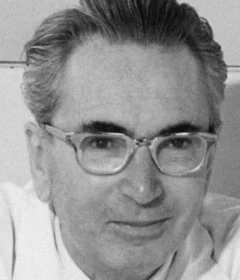
03Viktor Frankl
A life answers to something beyond itself
Frankl begins by changing the direction of the question. Alongside asking what we want from life, he asks what this particular situation asks of us. The answer is neither a universal mission statement nor a feeling we can manufacture. Meaning belongs to the encounter between a singular person and a concrete possibility: work to undertake, someone to love, a limit to meet. This is a philosophical claim about what matters, not a psychological finding that everyone can always feel purposeful.
His distinctive insistence is that explaining a person's conditions does not exhaust who that person is. But the dignity protected by that insistence must remain distinct from a demonstrated capacity to respond here and now.
T1 · Acting within a situation
Conditions are real: a body can be ill, a household can lack money, a person can be imprisoned. Frankl nevertheless defends a noetic, or specifically personal and spiritual, freedom to take a position toward conditions. This is stronger than saying that some practical choices remain. An appeal to that freedom cannot establish which action an exhausted or impaired person can actually perform. That requires a separate assessment.
T2 · Answerability without total authorship
Responsibility means answering for a possible response, not having created every circumstance or controlled every outcome. Frankl fears that explaining a person entirely through causes can erase their standing as someone answerable. Yet his association of guilt with dignity leaves a difficult boundary insufficiently developed: respecting someone as a person does not prove they could have acted otherwise. His ethical appeal cannot replace a judgment about actual culpability.
T3 · Owning desires while being socially formed
A desire's history and its object are different questions. Prestige may explain why a career attracts me. It does not settle whether its daily work serves anything worthwhile. Frankl asks whether wanting reaches beyond conformity and self-confirmation toward genuine meaning. Conscience helps discern that demand but can err. His account therefore resists causal reduction without supplying Fromm's detailed explanation of how society forms the very voice of conscience.
T4 · Commitment without guarantees
A commitment can answer a real meaning without a guarantee of success. Caring for someone matters even when the outcome remains uncertain. For Frankl, this is not simply our decision to confer value: the situation makes a claim upon us. Fallibility concerns our recognition of that claim. We need not comprehend an ultimate meaning of existence before responding to a concrete task, but his confidence that meaning remains possible is philosophically demanding.
T5 · Relationship without self-erasure
Love encounters the other's singularity rather than merely satisfying a need of mine. Through this movement beyond self-preoccupation, fulfillment may follow without becoming the relationship's target. Seeing another's possibilities, however, cannot authorize choosing their destiny. That limit follows from Frankl's refusal to prescribe someone else's meaning. It is an interpretive implication, not a fully developed political account of reciprocity.
T6 · Continuity through becoming
Change need not recover an untouched earlier self. A new task can redirect a life. Frankl also claims that fulfilled possibilities are secured in the past: what was genuinely lived is not annihilated by its passing. This gives continuity a stronger basis than remembering previous achievements. It is a philosophical response to transience, whose consoling force and justification must be considered separately.
T7 · Changing suffering, meeting irreversibility
Avoidable suffering calls for remedy and resistance. Irreversible loss raises a different question: whether a meaningful response remains possible after the injury. Neither possibility makes suffering necessary or justifies whoever caused it. Frankl sometimes elevates such responses exceptionally highly. The resulting pressure toward heroism is a real risk within his work. Failure to find meaning must never be inferred to establish the sufferer's moral failure.
T8 · Shaping life while allowing response
We can address remediable causes and direct attention toward someone or something that matters. We cannot reliably command fulfillment by monitoring whether we feel fulfilled. Self-transcendence names this orientation beyond the self, not a mental switch or universal surrender. Care may help make a response possible. The philosophical affirmation of personhood does not establish that any particular intervention will succeed.
Frankl's noetic freedom is a substantive philosophical commitment, not an established empirical theory of agency. His recognition of material needs, clinical difficulty, and avoidable suffering rules out crude positive thinking. It does not resolve every tension in his universal language. Personhood, effective capacity, meaning, and culpability must remain distinguishable throughout this conversation.
The question this position puts to Tom
The reconstructed challenge to Tom is this: what makes a humane, revisable commitment true to the situation, beyond its sincerity or usefulness? Scientific correction can improve knowledge of conditions, and compassion can guide response, but neither automatically answers Frankl's question about the meaning that calls for this response. Nonattachment may loosen possessiveness. Does it preserve an obligation that can contradict preference? Commitment to an unresolved life still owes an account of what the commitment answers to.
Tom’s answer and what remains open ↓Erich Fromm
↓ 04
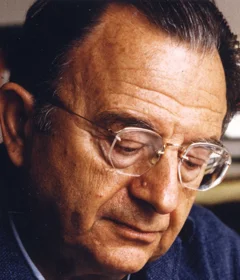
04Erich Fromm
Learning to want, and learning to live
Fromm brings a disturbing possibility to the table: I can sincerely want the life my society needs me to want. No secret manipulator is required. Family, work, authority, and reward enter character until an external requirement becomes an experienced desire. Sincerity therefore begins the inquiry into ownership. It does not finish it. Yet social formation alone cannot invalidate a desire, because our capacities for language, solidarity, and love also develop with others.
His alternative is productiveness: the living exercise of human powers in thought, love, and work. This means neither higher output nor a more successful personal brand. It supplies a substantive standard for asking what our adaptation is doing to us.
T1 · Acting within a situation
Release from authority can bring isolation alongside opportunity. Positive freedom requires capacities for independent thought, loving relationship, and active work. Those capacities are formed, not simply summoned. In Man for Himself, he argues that decisions are determined by character. Later formulations distinguish degrees of determination and real alternatives. Initiative matters, but an appeal to willpower cannot supply the personal development or social conditions on which effective choice depends.
T2 · Answerability without total authorship
We can judge conduct destructive without appointing ourselves a superior authority entitled to condemn its bearer. Fromm makes that distinction sharper than a simple plea for leniency. Understanding how character developed may unsettle accusatory judgment while leaving the damage clear. Yet his severe language about unrealized human powers creates its own difficulty: humanistic evaluation must explain how it avoids becoming another form of condemnation.
T3 · Owning desires while being socially formed
The marketing orientation makes the self feel like an offering whose worth depends on demand. Constant adaptability can then mean becoming whatever attracts approval. Fromm asks three separate questions: is this desire sincerely felt, how was it formed, and what kind of life does pursuing it produce? The answer cannot be an untouched self outside society. It concerns whether socially formed activity develops powers or turns the person into a commodity.
T4 · Commitment without guarantees
Active hope commits to possibilities without predicting inevitable progress. The future is open, but its possible forms are not equally good: some support reason, love, and solidarity. Others damage them. Fromm's humanism therefore supplies more than permission to choose values. Its claims remain revisable, while requiring an argument for the account of human flourishing that makes one commitment better than another.
T5 · Relationship without self-erasure
Love is a capacity practiced through care, responsibility, respect, and knowledge. Responsibility means responding to need. Respect prevents that response from turning into possession. Mature union preserves both participants' integrity. Practice can deepen my capacity to love, but cannot make another person love me. Nor should Fromm's dated assumptions about sex and gender be smuggled into this account as universal truths about intimacy.
T6 · Continuity through becoming
Transformation requires recognizing suffering, understanding its sources, seeing an alternative, and changing practice. Institutional reform and personal change must support one another. Neither automatically completes the other. Continuity need not mean protecting a fixed character. It can involve developing human capacities through new orientations. The demanding question is whether reinvention expresses greater living activity or merely equips us to remain saleable under changing demands.
T7 · Changing suffering, meeting irreversibility
A whole society can normalize arrangements that damage people. Successful adjustment is therefore an inadequate measure of health. Fromm asks whose suffering is being made invisible and which causes can be changed. Mortality, separateness, and uncertainty remain. Social criticism does not promise their abolition. But acknowledging irreversible loss must not protect preventable injury or turn every experience of distress into a lesson in personal growth.
T8 · Shaping life while allowing response
Discipline and reason can cultivate living capacities. The difficulty begins when having substitutes for being: accumulating possessions, status, or control in order to secure a self. Fromm does not demand abandoning the material provisions life requires. He distinguishes necessary possession from a character organized around possession. Relinquishing domination, especially in love, should deepen responsible participation rather than become an excuse to stop caring.
Fromm's human powers are a normative conception of flourishing, not uncontested biological facts. His account can criticize sincerely satisfying adaptation, but then must justify who may call another person's fulfillment impoverished. The risk of paternalism survives alongside the force of his social criticism. His different formulations of character and choice should also retain their historical differences.
The question this position puts to Tom
The reconstructed challenge to Tom is whether an unresolved life can still be lived inside a socially manufactured horizon of wanting. Flexibility may be admirable, or it may mean adapting efficiently to damaging demands. Compassion and nonattachment need an account of which human powers they develop and which institutions permit those powers to grow. Invoking Fromm's humanism also accepts its burden: justify the human ideal, and connect inner practice with changes in work, authority, and material life.
Tom’s answer and what remains open ↓Simone de Beauvoir
↓ 05
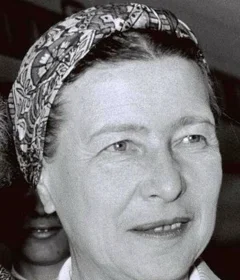
05Simone de Beauvoir
Freedom has a body, a history, and other people
Beauvoir makes ambiguity a condition of existence, not a temporary shortage of information. We are subjects who act and bodies others can constrain. Finite beings who reach beyond the given. Separate people whose projects need a shared world. No final viewpoint makes these tensions disappear. The ethical task is to act within them while opening possibilities for other freedoms.
This prevents two shortcuts at once. Declaring someone free does not give them concrete opportunities. Explaining their situation does not automatically decide every ethical question. The body, social position, and past are part of how possibilities are lived, not obstacles added to an otherwise complete, disembodied will.
T1 · Acting within a situation
Distinguish the structure of projecting beyond the given, the concrete opportunity to act, and the ethical use of freedom. They are not equivalent. Someone denied education or confined by oppression may be prevented from recognizing alternatives at all. An appeal to initiative must therefore ask what others need to change. Embodied limitation also matters. It cannot be classified as evasiveness merely because an observer imagines another choice.
T2 · Answerability without total authorship
Responsibility concerns acts, means, and the situations we help create for others. Circumstances and ignorance matter without automatically cancelling judgment. In her writing on punishment, Beauvoir keeps the offender's humanity and possible future in view while defending severe accountability for atrocity. She offers no easy formula of forgiveness. Neither reducing a person to one deed nor dissolving the deed into its causes adequately answers those harmed.
T3 · Owning desires while being socially formed
Desire takes shape within hierarchies that teach us what is natural, respectable, or imaginable. An imposed role can become a lived limitation. Saying that a project is my choice cannot by itself justify its effects on others. But neither should the oppressed person's apparent acceptance be treated automatically as evasion: the difference between refusing an available possibility and never having an effective route toward it is ethically decisive.
T4 · Commitment without guarantees
Projects gain significance through commitment and their opening toward other freedoms. No completed order guarantees them from outside human existence. This does not make every commitment equally defensible. A project that suppresses the freedom through which value becomes possible contradicts the ethical demand. Uncertainty therefore accompanies judgment rather than suspending it. Refusing to act cannot guarantee innocence, and a claimed historical necessity cannot cleanse harmful means.
T5 · Relationship without self-erasure
Others are more than obstacles to independence: their freedom gives my projects a future beyond me. Reciprocity preserves separate subjects. Devotion fails when the recipient becomes material for the giver's preferred identity or plan. I may improve conditions, offer help, and make an appeal. I cannot live another's freedom for them. Dependence can support freedom, while self-sacrifice can conceal domination or erase the person doing the caring.
T6 · Continuity through becoming
A settled identity cannot discharge the work of choosing. Being a professional, a victim, or a hero never contains the whole future. Yet revision does not erase the past or bodily dependence. We may renew or relinquish projects while remaining answerable for promises and consequences. Social liberation can enlarge possibilities without abolishing ambiguity. Transformation does not restore every lost life or opportunity.
T7 · Changing suffering, meeting irreversibility
Resist preventable injury and oppression without promising that a better future redeems everyone sacrificed along the way. A loss can remain unreconciled even when action was necessary or later change beneficial. This is not a prohibition on all force: political choices can be tragic. It is a refusal to erase particular victims inside a supposedly successful whole. Meaning, justice, and acknowledgment cannot substitute for one another.
T8 · Shaping life while allowing response
We should shape conditions while accepting that another's free response cannot be authored in advance. The means are already part of the future we claim to seek. Receptivity therefore does not excuse passivity toward domination, and decisive action does not authorize possessing another's project. The question is whether our intervention opens a future for them or merely secures the result through which we justify ourselves.
Beauvoir's thought develops. Early distinctions can shelter interior freedom too sharply from circumstances. Later attention to oppression and embodiment complicates them. Her account should not be made uniformly complete from the beginning. Even its strongest version provides demanding ethical criteria, not a procedure that resolves every conflict between particular freedoms. Ambiguity survives greater knowledge and greater justice.
The question this position puts to Tom
The reconstructed challenge to Tom asks: whose freedom does this commitment enlarge, and who pays for its flexibility? Revising one's life may place costs on people who lack an equal power to revise theirs. Compassion must face those concrete asymmetries. Scientific understanding cannot provide a final moral standpoint, and nonattachment cannot exempt means from judgment. Most sharply, an unresolved life must allow losses to remain unreconciled. The beauty of the whole cannot redeem each person harmed within it.
Tom’s answer and what remains open ↓Hartmut Rosa
↓ 06
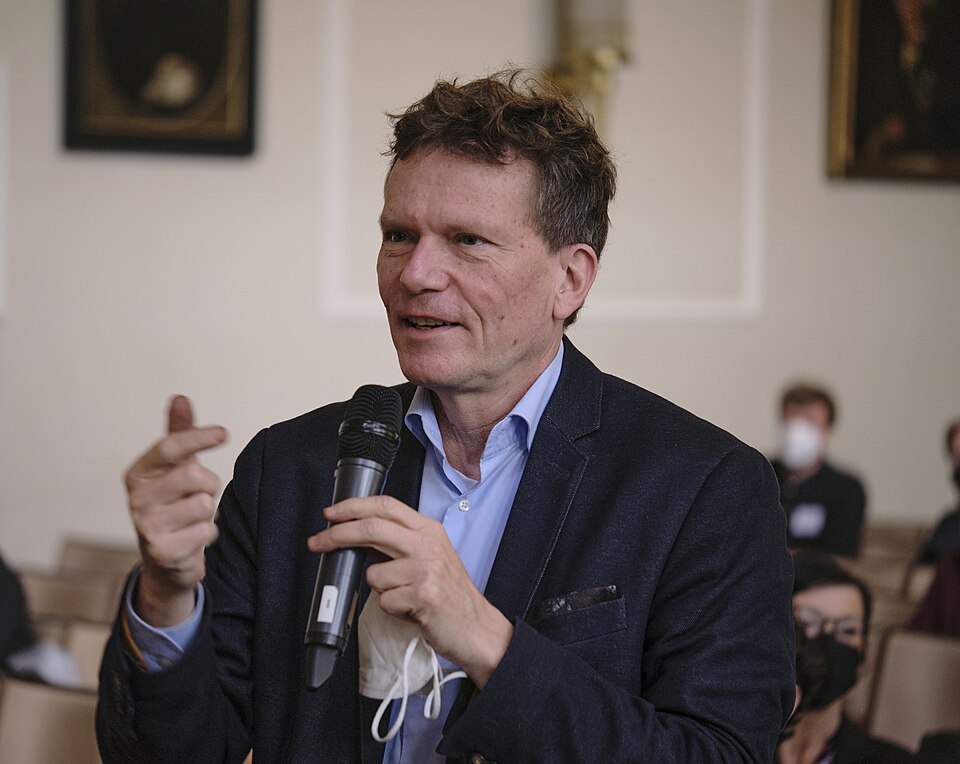
06Hartmut Rosa
A world that can answer back
Rosa asks why gaining more choices, resources, and control can leave life strangely unresponsive. His answer begins with social organization. Modern institutions often maintain themselves through continued growth, innovation, and acceleration: dynamic stabilization. Standing still can require continual movement. The resulting problem cannot be reduced to an individual's poor scheduling or inability to relax.
Resonance names a different relation: something affects us, we answer in our own voice, and the encounter transforms us through an outcome we cannot fully command. It is neither permanent harmony nor a pleasant mood. The social conditions of such relationships matter, alongside our capacity to enter them.
T1 · Acting within a situation
Ask why maintaining an ordinary position demands so much effort. Technological acceleration, faster social change, and a faster pace of life are related but distinct. Their institutional organization affects which relationships people can sustain. This does not mean every process becomes faster: waiting, exclusion, and enforced inactivity can accompany acceleration. An individual choice to set a boundary may remain costly where work and security depend on constant availability.
T2 · Answerability without total authorship
A demand to become more resonant can become another requirement to optimize oneself. Rosa redirects attention toward institutions that enable or obstruct responsive relationships. That changes the framing of responsibility: a socially organized problem should not be assigned entirely to private failure. It does not provide a complete doctrine of blame. Whether someone owes an apology, deserves condemnation, or lacked an alternative still needs further ethical judgment.
T3 · Owning desires while being socially formed
Examine what relation an aspiration establishes. Acquiring access to more of the world can expand possibilities while leaving everything experienced as resource, obstacle, or competition. A desire is not alienated merely because society rewards it. The question is whether its pursuit permits the world to address and change us. Rosa does not thereby supply Fromm's account of unconscious character formation. Their critical questions intersect without becoming identical.
T4 · Commitment without guarantees
Commitment can cultivate a lasting relationship without guaranteeing any particular resonant encounter. A friendship, practice, or place may remain important through periods when it feels silent. When response does arrive, it may change the values with which we entered. This openness does not settle moral justification: critics ask whether resonance presupposes ethical standards that the experience itself cannot establish. Transformation alone cannot certify its own goodness.
T5 · Relationship without self-erasure
Resonance requires distinct voices. An echo that merely confirms me is not enough. A relationship may be demanding or disturbing and still permit mutual response. Conversely, collective enthusiasm does not settle its moral status, especially when outsiders are excluded. Rosa also rejects making literal speech or hearing a condition of personhood: responsiveness must not become a sensory standard that disqualifies people with disabilities.
T6 · Continuity through becoming
A self can remain recognizable while being transformed through relation. Stable practices and enduring axes of relationship help sustain opportunities for encounter. Perpetual novelty is unnecessary. A real dispute remains over how ordinary repetition and cultivated routine support something that cannot be manufactured. Rosa's distinction between lasting relationships and particular experiences partly answers that challenge without eliminating it. Continuity prepares a possibility. It does not program its result.
T7 · Changing suffering, meeting irreversibility
Pain need not exclude resonance, but uncontrollable suffering does not guarantee it. A catastrophe can make the world feel inaccessible or hostile. The task is to resist harmful conditions and support possibilities of response without commanding the sufferer to experience them. Irreversible loss remains a loss. Neither a resonant moment nor a socially improved situation establishes that the original injury was necessary or good.
T8 · Shaping life while allowing response
Knowledge, material security, practical competence, and some instrumental relations remain necessary. Uncontrollability is a condition of resonance, not a sufficient cause: arbitrary danger is uncontrollable too. We can organize time and protection for encounter while leaving the other's response undetermined. A plan that guarantees exactly what another will say removes the independent voice we hoped to meet. Slowness alone cannot repair this relation.
Resonance combines being affected, responsive efficacy, transformation, and an outcome unavailable to full control. It is not relaxation, uninterrupted intimacy, or a moral certificate. Ordinary distance and functional relations have legitimate places. Critics' questions about exclusion, justice, and the theory's normative foundations remain relevant alongside Rosa's replies. The concept should not be promoted into a complete account of the good.
The question this position puts to Tom
The reconstructed challenge to Tom asks what happens when a flexible, compassionate life remains subject to institutions that must keep accelerating. Personal nonattachment cannot by itself change dynamic stabilization. Which arrangements would give people time, security, and an effective voice? A second challenge concerns the promise of the thesis itself: commitment may support responsive relationships, but cannot guarantee resonance. Even a carefully reasoned, humane life must remain open to an answer it neither predicts nor controls.
Tom’s answer and what remains open ↓Tom makes a proposal and must answer
↓ 07
07TOM · FLOW HIJACKED · A PROPOSED SYNTHESIS
Commitment to a life that remains unresolved
Tom’s words are authored for this lecture. This is a proposed position, not a conclusion proved by science.
I speak here as Tom, in a proposed response authored for this conversation. What follows is a formulation of Flow Hijacked's commitments for consideration, not a historical dialogue or a claim that these four thinkers would endorse my position. Their questions remain capable of changing it. Frankl asks what calls for my response. Fromm asks what kind of person and society my desires sustain. Beauvoir asks whose freedom my project enables. Rosa asks whether the world can still address me. These questions overlap, but their standards of judgment do not become identical.
My starting commitment is to a life that remains unresolved. I mean a life in which love, responsibility, grief, uncertainty, and the need to act continue without a final explanation that puts everything in its place. Some questions lack an answer today. Others may never admit a final answer of the kind we want. Why this loss? What could make an entire life justified? I can acknowledge those questions without requiring the next act of care to solve them.
I choose compassion, truthful inquiry, and resistance to domination as commitments I must defend in public and enact in relationships. They do not follow automatically from a brain scan, a moving story, or an experience of connection. Nor does choosing them make them immune to criticism. The fifth chair carries a responsibility to say where its judgments come from, what would count against them, and who bears their costs.
This is where firmness and flexibility meet. I need enough firmness to keep a promise through discomfort, and enough flexibility to recognize when my way of keeping it has become harmful. Commitment sometimes closes possibilities forever. A life cannot preserve every alternative and also give itself to anything. My proposal is to choose and remain answerable, while accepting that neither sincerity nor later growth will undo every consequence.
Dignity before demonstrated capacity
I begin with the worth of the person whose powers are presently diminished: someone exhausted, dependent, ill, frightened, or unable to tell a coherent story about themselves. I do not make dignity a reward for agency, productivity, insight, or recovery. The ability to choose a response is a question to investigate in this situation. The person's claim to care does not wait for the investigation's favorable result. An invitation to act must remain attentive to what is actually possible.
Compassion also reaches people harmed by another person's conduct. Understanding the history of someone who inflicted harm does not give me authority to ask the injured person to forgive, reconcile, or remain exposed. Protection, acknowledgment, repair, and proportionate judgment may all be necessary. My refusal to reduce a person to their worst act leaves the act available for clear judgment and leaves its victims free to set boundaries.
Listen to experience. Examine claims
Different narratives can disclose different parts of a life. A person may understand the same period through illness, learning, betrayal, devotion, or survival. I want to hear what each account makes visible and what it conceals. Lived experience deserves serious attention without being promoted into proof of every explanation attached to it. Feeling abandoned is real as an experience. The claim that every person deliberately abandoned me remains open to factual inquiry.
My proposed discipline has three movements: listen to the experience, verify factual claims as far as evidence permits, and judge actions and consequences. These movements sometimes pull against each other. A comforting story may misidentify a cause. An accurate explanation may be offered with cruelty. A sincerely held narrative may authorize domination. Compassion requires staying with these difficulties. Agreement with every account would make it harder to protect people whose suffering that account excludes.
Firm commitments, revisable ways
Firmness means that inconvenience, anxiety, or a more attractive alternative does not automatically release me from a promise. Flexibility means I attend to changed circumstances, new evidence, and the people affected. Neither gives me a formula for deciding when to persist. I can continue through difficulty for good reasons, and I can continue because admitting error threatens my identity. Honest revision asks which of these is happening and gives others standing to challenge my answer.
A serious commitment spends time that cannot be recovered and creates expectations on which others may build. Leaving can be justified and still cause loss. Staying can be loyal and still require a different arrangement. I therefore reject endless option preservation as the measure of freedom. What matters is whether I can account for the commitment, recognize its costs, change harmful means, and accept obligations that survive my decision to change direction.
Science disciplines the account
Science can correct my assumptions about what people can do and which conditions support change. Bonanno and Burton's 2013 theoretical review offers a useful framework for regulatory flexibility: sensitivity to context, a repertoire of possible regulatory strategies, and responsiveness to feedback. It reviews evidence and limitations. It does not experimentally establish my moral position. I use its framework to ask more precise questions about responding to changing demands, without declaring any single strategy universally right.
The ethical step remains mine. Effective adjustment can serve an unjust institution as readily as a humane project. A description of successful regulation cannot tell us whose interests deserve protection or what sacrifices may be demanded. I choose to assess flexibility by its consequences for truthful understanding, dignity, care, and freedom from domination. These are openly defended commitments. Scientific findings can constrain how I pursue them. No neural description supplies their moral authority.
The raft and the humanist question
I draw selectively on a specific Buddhist image, the raft in the Alagaddūpama Sutta, Majjhima Nikāya 22. A traveler constructs and uses a raft to cross dangerous water, then need not carry it onward after reaching safety. The sequence matters: the raft is relinquished after the crossing. The teaching concerns how to hold and eventually release the teaching itself. It cannot honestly be reduced to abandoning every commitment whenever attachment feels uncomfortable.
My adaptation is limited: I want to hold a method carefully enough to use it, and loosely enough to stop treating it as sacred when its work is done. I place that image beside Fromm's humanistic concern with care, reason, respect, and living powers. Fromm helps me ask what the crossing is for and whom it serves. Their traditions retain different aims and foundations. This combination is my proposed Flow Hijacked ethic. I do not attribute it to the Buddha or present it as the wisdom of an undifferentiated East.
Build conditions. Accompany what cannot be repaired
A livable commitment requires more than a better account of oneself. Income, housing, accessible care, protected time, and institutions that limit coercion can determine whether a promise is possible to sustain. Asking a depleted caregiver to find a more generous narrative leaves the distribution of care untouched. I must also ask who can share the work, which services are missing, and which rules make help inaccessible. These are material and political responsibilities within my proposal.
I also refuse to describe suffering as a gift, a deserved lesson, or a necessary purchase price for depth. We should contest avoidable injury and remain cautious when powerful people declare a hardship inevitable. Where a loss cannot be reversed, accompaniment can continue without explaining it away. A person may eventually find meaning in their response. That meaning belongs to their life. It does not acquit the injury, restore what was lost, or impose the same task on someone else.
Four objections. Four answers that do not close the discussion.
Viktor Frankl
AN OBJECTION RECONSTRUCTED FROM THE POSITIONReconstructed challenge: If commitments remain revisable, what gives them authority beyond your present preference?
Tom responds
Viktor, your challenge identifies a real weakness. I cannot answer it merely by saying that my commitments feel sincere or help me function. You ask whether something outside my convenience genuinely calls for a response. When someone depends on a promise I have made, their need confronts me independently of my present enthusiasm. My proposal must leave room for that demand and for the discovery that I have been evading it.
I defend commitments through reasons others can contest: the reality of suffering, the claims created by relationships, the harm of domination, and the costs we impose. This gives judgment substance without proving your stronger claim that each situation contains a meaning awaiting discovery. I may encounter a demand I did not invent while remaining uncertain about its ultimate foundation. I also keep dignity separate from any verdict that a particular person could have responded otherwise.
My answer is therefore partial. I can explain why I refuse to treat another person as disposable and how that refusal governs my conduct. I cannot offer a final proof that dissolves every challenge to its authority. Your question remains at the table, asking whether my chosen fidelity is enough.
Can publicly defended commitments bind us sufficiently without Frankl's account of discoverable meaning?
Erich Fromm
AN OBJECTION RECONSTRUCTED FROM THE POSITIONReconstructed challenge: How do you know that your celebrated flexibility is not the market's demand speaking through you?
Tom responds
Erich, this is a genuine danger inside my proposal. A person can sincerely call endless adaptation growth while becoming more saleable and less able to love, think, or refuse. If I praise flexibility without asking who requires it, I can turn a vocabulary of freedom into another instrument of compliance. Your account of social character makes sincerity insufficient evidence that a desire deserves authority.
My partial answer is to examine both the activity and its conditions. Does it cultivate capacities for care, understanding, and participation? Can the person refuse without losing the necessities of life? Does the institution allow durable commitments, or reward the continual replacement of the self? These questions require changes in working arrangements, material security, and shared power as well as reflection. The dignity of someone whose powers remain limited must survive every answer.
I accept your demand for a substantive account of humane life while keeping that account open to criticism from those it claims to serve. I cannot stand entirely outside the society that shaped my own ideals. Our disagreement remains over how confidently we can identify universal human flourishing and how to prevent an ideal of development from becoming another judgment against dependency.
Which account of human flourishing can guide criticism without ranking people's worth by their realized capacities?
Simone de Beauvoir
AN OBJECTION RECONSTRUCTED FROM THE POSITIONReconstructed challenge: Who pays for your commitment, and can your language of openness evade the irreversible decision?
Tom responds
Simone, you expose a real temptation: I can keep describing complexity until the moment for action passes, or praise my compassionate intentions while someone else bears the damage. Openness has no ethical privilege merely because it feels generous. A decision may be necessary before agreement is possible. It may close another path permanently. I must name the people affected and the freedoms my project requires, restricts, or makes possible.
My partial response is to accept decisions with consequences, including the obligation to oppose domination and the responsibility to answer for the means I use. Revisability applies to future judgment and conduct. It cannot make the past reversible. When changing course, I still owe acknowledgment, repair where possible, and attention to promises on which others relied. Material opportunities matter here: telling someone to undertake a project is empty when coercion forecloses the means.
I have no procedure that makes every conflict innocent. Protection can require actions that leave a remainder of loss. Competing legitimate claims may resist reconciliation. Compassion should sharpen my perception of that remainder. It cannot issue an advance pardon. Your challenge remains wherever my account of humane action makes its own costs disappear.
How should we decide when legitimate freedoms conflict and no action avoids serious loss?
Hartmut Rosa
AN OBJECTION RECONSTRUCTED FROM THE POSITIONReconstructed challenge: Does your commitment still treat the world as a project whose response you intend to manage?
Tom responds
Hartmut, your question reaches a real limit of my language. I can organize a life so conscientiously that nothing is allowed to surprise me. Even care can become a schedule against which another person's response is evaluated. A world permitted only to confirm my intentions cannot really answer. I therefore need practices and relationships in which listening can alter the person who arrived with the plan.
My partial answer is to distinguish providing conditions from guaranteeing an encounter. I can defend time, access, continuity, and protection from coercion. I cannot require affection, resonance, or transformation to occur. Institutions carry responsibility for those enabling conditions. This cannot become a private assignment to feel more connected. Equally, the intensity of a shared experience cannot establish its justice. Other voices, including those excluded from the encounter, retain a claim to be heard.
I want room for ordinary duty and necessary administration as well as responsive encounters. Some worthwhile care feels repetitive, silent, or unrewarding. A person remains worthy when the world feels mute. Your challenge persists because even my effort to create room for response can become another management technique, and I cannot specify in advance the encounter that would free it from that tendency.
How can we sustain responsive relationships without turning receptivity into another demand or neglecting justice?
The eight tensions return as proposed movements
T1 · Acting within a situation
Acting within a situation: I ask what this person can actually undertake, what support would widen that possibility, and who must provide it. Frankl's affirmation of the person does not establish equal practical capacity. Fromm, Beauvoir, and Rosa help expose formed dispositions, blocked opportunities, and institutional demands. I hold dignity constant while keeping the assessment of agency specific and revisable.
T2 · Answerability without total authorship
Answerability without total authorship: I separate explaining an act, assessing culpability, protecting those harmed, and arranging repair. These questions can have different answers. The four thinkers do not offer one shared theory of blame. My synthesis retains causal understanding and the need for judgment, while refusing to infer either unlimited responsibility or automatic innocence from a person's history.
T3 · Owning desires while being socially formed
Owning socially formed desires: I cannot purify a wish of every influence. I can investigate its formation, its object, the freedoms it affects, and the relation to the world it sustains. These inquiries preserve the four thinkers' different standards. A socially learned desire may deserve my commitment. A deeply sincere one may require refusal. Listening to its story begins the judgment without settling it.
T4 · Commitment without guarantees
Commitment without guarantees: I accept that a promise must sometimes precede confidence and that choosing can irreversibly close alternatives. The four thinkers allow serious action under uncertainty while disagreeing about its authority. My proposal makes that authority an explicit ethical question, then asks me to act on reasons I can defend and to bear responsibilities that outlast my certainty.
T5 · Relationship without self-erasure
Relationship without self-erasure: I can be changed by another person while retaining a voice and recognizing theirs. Care requires knowledge of concrete needs, respect for refusal, and fair distribution of its burdens. Frankl's singularity, Fromm's cultivated love, Beauvoir's reciprocal freedom, and Rosa's responsive voices illuminate different failures. Their conjunction offers tests for my conduct, without making care a right to author someone else's life.
T6 · Continuity through becoming
Continuity through becoming: I can honor what I have lived and still cease to identify with an earlier project. Frankl's secured past and Beauvoir's irrecoverable losses do not yield the same consolation. Fromm and Rosa also give transformation different directions. I preserve continuity through remembered obligations, honest acknowledgment, and renewed practice, without promising that every past investment will be redeemed.
T7 · Changing suffering, meeting irreversibility
Changing suffering, meeting irreversibility: I investigate remedies before calling a hardship inevitable, and I refuse to make personal meaning a substitute for justice. A loss that cannot be reversed can coexist with harms that still can be prevented. The task may become accompaniment, protection, or practical care. None requires the sufferer to declare growth, gratitude, resonance, or a final reconciliation with what happened.
T8 · Shaping life while allowing response
Shaping life while allowing response: I prepare the meal, protect the time, and make the invitation. I leave the encounter able to answer otherwise. Practical control remains necessary for care and safety. The limit concerns commanding another person's response or demanding fulfillment from every activity. My commitment is to sustain conditions and attend to what happens, including the possibility that the plan itself needs to change.
I leave the fifth chair with commitments and unanswered questions. I will try to relieve what can be relieved, oppose what should not be endured, and remain present where repair has limits. I will listen to the story, examine the claim, and answer for the act. I will sometimes have to choose before I know enough, and live with a door that choice has closed. The unresolved character of life does not make these acts meaningless. It makes the way we undertake them, and the conditions we secure for one another, matter now.
When the 21st century takes a seat
The following six cases are illustrative scenarios. They test the proposal without forecasting a future or claiming agreement among the thinkers.
A desire that has a history
Imagine someone who keeps encountering recommendations for a particular kind of career, appearance and life. Eventually, this future feels intensely personal. The person asks whether discovering the influence would make the desire less genuinely their own. This is a hypothetical case, not a prediction about any platform.
Tom’s proposed response
I would ask what becomes possible when the person can examine this desire without humiliation. A social history does not automatically invalidate an aspiration. Yet sincerity cannot be its only defense. We can ask what the aspiration serves, whom it affects and whether other ways of living remain imaginable. This requires conditions for reflection, including time, alternative encounters and some protection from commercial pressure. Science can investigate influence. It cannot decide which life deserves our allegiance.
There is no uncontaminated self waiting outside society to certify the answer. Nor does examining a desire ensure freedom from its influence. A considered commitment may still carry dependence and uncertainty.
Carry to the next table
What would help someone endorse a desire responsibly, without requiring an impossible freedom from all influence?
When usefulness no longer secures a place
Imagine a workplace considering a system that, in this hypothetical case, can perform many paid tasks. Workers face lost income, while managers promise shorter hours without specifying who will receive them. One worker hears the proposal as a judgment on the value of their entire life.
Tom’s proposed response
I would defend the person's dignity before asking them to reinvent themselves. Income, recognition, useful activity and belonging are connected, but they are not identical. A humane response must consider how security, time and decision power are distributed. Workers need a voice in that decision. Personal learning may help, but cannot carry the entire burden of institutional change. My claim that human worth exceeds market usefulness is an ethical commitment. No performance comparison between a person and a machine can prove or disprove it.
Protecting dignity does not specify which jobs must remain, how resources should be shared or what recognition replaces a lost vocation. There may be costs that no appealing account of progress erases.
Carry to the next table
Who should decide what technological gains are for, and what must remain secure when a person's usefulness changes?
A promise without possession of the future
Imagine a community planning homes, schools and care for the next generation while uncertain about its future climate and resources. A parent wonders what it means to promise a child a future. The scenario tests commitment under uncertainty. It makes no empirical forecast about a particular place.
Tom’s proposed response
I cannot honestly promise that everything will be all right. I can make commitments about what I will help protect, which harms I will resist and how I will remain answerable when conditions change. Private reassurance needs collective substance: shared decisions, resources and sustained attention to those with less power. Scientific knowledge should inform our understanding of consequences. Choosing how much we owe people who cannot yet answer us remains an ethical and political responsibility.
Love does not authorize us to promise safety we cannot provide. Uncertainty also cannot excuse every postponement. Present needs and future protection may genuinely compete, and the people bearing their costs are not interchangeable.
Carry to the next table
Which promises remain honest when outcomes are uncertain, and who is entitled to demand that we keep them?
Two stories do not make every claim true
Imagine two communities describing the same public confrontation. Each remembers fear and humiliation. Their accounts also disagree about who threatened whom and what happened first. Both demand recognition. This hypothetical conflict separates the reality of an experience from the accuracy of every claim made about an event.
Tom’s proposed response
I want enough compassion to hear what each account protects and enough firmness to investigate what happened. Understanding fear does not make every response permissible. Recognizing an injury does not require accepting an inaccurate accusation. We need evidence, opportunities to correct the record and protection for people whose testimony carries little power. A shared conversation may begin before a shared narrative becomes possible. Its ethical floor includes stopping harm and preserving the possibility of disagreement without humiliation or coercion.
Evidence may remain incomplete. Recognition can be withheld even after facts become clearer. No demand for mutual understanding should force an injured person to reconcile or imply that responsibility is always symmetrical.
Carry to the next table
Which claims need checking, which injuries need acknowledgment, and which actions must stop before a common story becomes possible?
Dignity when a reply becomes difficult
Imagine a family accompanying someone near the end of life who can no longer consistently express their wishes. Earlier wishes conflict with relatives' present hopes, and unpaid care falls mainly on one exhausted person. This hypothetical scene concerns dignity, representation and the distribution of care, without prescribing a treatment decision.
Tom’s proposed response
The person's dignity does not diminish with their ability to answer. Neither does a caregiver's exhaustion reveal a failure of love. I would ask whose wishes are represented, whose labor has disappeared from view and what support is actually available. Respect requires attention to the person's history and present situation, together with acknowledgment of uncertainty. A commitment to care may require changing how care is shared. It cannot fairly depend on one person's unlimited sacrifice.
Earlier commitments, present comfort and competing responsibilities may resist a clean resolution. Institutions cannot guarantee a peaceful ending. No later meaning cancels the loss, and nobody owes us a consoling interpretation of it.
Carry to the next table
How can we remain faithful to a person whose voice is harder to hear without erasing those who care for them?
Surviving today without endorsing the arrangement
Imagine a worker using breathing practice to endure a schedule that leaves little time for sleep or family. Refusing shifts could threaten the rent. The practice helps today, while management calls the arrangement sustainable. The example is hypothetical and makes no claim about the effectiveness of a particular practice.
Tom’s proposed response
I would not take away what helps the person get through the day. I would also refuse to treat endurance as proof that the conditions are acceptable. Personal support and collective change can proceed together, although the worker may not be able to carry both. The practical question concerns real alternatives, shared protection and who has power to change the arrangement. Science may help describe its consequences. Deciding whose time and wellbeing can be spent for whose benefit requires ethical judgment.
Resistance can carry unequal risks. Asking the least protected person to become a hero may repeat the injustice. Yet accommodating every demand indefinitely can leave the harmful arrangement intact.
Carry to the next table
What would make refusal safer, and who besides the affected worker must take responsibility for making that possible?
The next meeting begins with what we did not resolve
The second table should begin with one hypothetical decision. A town is considering automating part of a public service. It must decide how to use any resulting resources, how to protect access for residents who need personal assistance and what it owes workers whose roles may disappear. Its budget is limited. No participant may assume that every legitimate need can be met without a cost.
Bring the same short case file to every chair: the stated alternatives, the assumptions that need checking, the affected people's accounts, the distribution of decision power and the uncertainties that remain. Separate established facts within the hypothetical case from disputed claims and proposed values. Include an account from someone who cannot easily attend the discussion.
The task is to produce a decision that can be examined and challenged. Each participant must name a commitment, confront its possible cost and specify what could change their judgment. Tom must submit his own synthesis to those requirements. The following agenda identifies the work the next conversation must do.
Frankl and Tom: what makes a meaning worth answering?
Can Tom distinguish a defensible meaning from a satisfying story without assuming an objective order he has not justified? If meaning is discovered, how do we assess rival convictions about what the same situation asks of us? Neither intensity nor sincerity settles the disagreement.
What the meeting should establish
Write two incompatible but sincere accounts of the town's duty. For each, separate factual assumptions, ethical commitments and claims about meaning. Name what could count against it. Preserve the remaining disagreement about the source of authority.
Fromm and Tom: which human powers should institutions protect?
What gives love, understanding, creative activity and participation their normative weight? Can Tom defend them without reducing flourishing to personal preference or assuming that a scientific description of human capacities already establishes their moral rank? How will the account include people whose capacities are restricted?
What the meeting should establish
Draft a short list of goods the service should support. Give an ethical reason for each. Show how support changes across different abilities while dignity does not depend on demonstrating those abilities. Identify one genuine conflict between the goods.
Beauvoir and Tom: who pays for the proposed good?
Whose concrete possibilities shrink under each proposal, and who has the power to call that sacrifice necessary? A coherent public purpose does not erase a particular person's loss. How can a decision remain accountable when some harms cannot be fully repaired?
What the meeting should establish
Produce a distribution sheet naming benefits, burdens, alternatives and opportunities to object. Mark irrecoverable losses separately. Ask an affected person to contest the proposal in their own terms. State which objection remains unanswered after revision.
Rosa and Tom: can an institution protect an encounter it cannot command?
Which arrangements allow residents and workers to answer one another rather than merely complete a transaction? How can the town support those conditions without promising resonance, demanding emotional participation or treating a feeling of connection as proof of justice?
What the meeting should establish
Design two service arrangements with different opportunities for personal response, privacy and refusal. Specify the time and resources each requires. Evaluate accessibility and power separately from reported connection. Leave the quality of any actual encounter unguaranteed.
All five chairs: when do conditions change responsibility?
How should we distinguish explanation, culpability, acknowledgment and repair when people act under unequal constraints? Compassion must reach the person who caused harm and the person who bears it. Their needs may still require different responses and firm limits.
What the meeting should establish
Add one preventable failure to the hypothetical service. Record what each actor knew, what alternatives were available and who controlled the conditions. Allocate duties of acknowledgment and repair without pretending that this alone settles every judgment of blame.
Tom under questioning: what should remain firm, and what must be revisable?
Who decides which commitments form the ethical floor when reasonable people disagree? How can a promise remain reliable while its implementation changes? Tom must explain when flexibility becomes evasion and when firmness becomes a refusal to see what a decision is doing to people.
What the meeting should establish
Write a provisional decision, its ethical reasons and a review process. Name who can request reconsideration, what evidence or testimony would trigger it, and which losses revision cannot undo. Do not treat reversibility as a condition every meaningful commitment can satisfy.
Bring three things to the next meeting: the proposed decision, the strongest unresolved objection and an account from someone who would live with its consequences. Give that account a real place in the discussion. The conversation advances when our commitments can encounter a reply we did not write for them, and when that reply can change what we actually do.
The lecture, its sources and their limits
The preparatory research contains 48 sources: six primary and six secondary for each thinker. Two further sources serve the discussion of flexibility and the raft analogy. Philosophical interpretation, empirical findings and normative synthesis have different roles here. Editions and bibliographic titles are preserved in their original language.
Two secondary sources, F09 and E11, were examined through partial previews only. No central claim depends on either alone. The English research dossier records the extent of examination for every source. Philosophical claims about freedom and meaning do not become scientific facts through proximity to neuroscience.
F01Viktor E. Frankl, Man's Search for Meaning: An Introduction to Logotherapy. Beacon Press, expanded fourth-edition text, 1992; original German work 1946. Part One translated by Ilse Lasch. .
Primary source
F02Viktor E. Frankl, “Time and Responsibility,” in The Feeling of Meaninglessness: A Challenge to Psychotherapy and Philosophy, edited by Alexander Batthyány. Marquette University Press, 2010, pp. 171–176. .
Primary source
F03Viktor E. Frankl, “The Philosophical Foundations of Logotherapy,” originally 1964; reprinted in Batthyány, ed., The Feeling of Meaninglessness. Marquette University Press, 2010, pp. 107–120. .
Primary source
F04Viktor E. Frankl, “Religion and Existential Psychotherapy,” in Batthyány, ed., The Feeling of Meaninglessness. Marquette University Press, 2010, pp. 193–202. .
Primary source
F05Viktor E. Frankl, “Self-Transcendence as a Human Phenomenon.” Journal of Humanistic Psychology 6, no. 2 (1966): 97–106. .
Primary source
F06Viktor E. Frankl, “Determinism and Humanism,” originally Humanitas 7, no. 1 (1971): 23–36; reprinted in The Feeling of Meaninglessness. Marquette University Press, 2010, pp. 157–170. .
Primary source
F07Stefan E. Schulenberg, Robert R. Hutzell, Carrie Nassif, and Julius M. Rogina, “Logotherapy for Clinical Practice.” Psychotherapy: Theory, Research, Practice, Training 45, no. 4 (2008): 447–463. DOI: 10.1037/a0014331. .
Secondary source
F08Claudia Reitinger, “Viktor Frankl's Logotherapy From a Philosophical Point of View.” Existential Analysis 26, no. 2 (2015): 344–357. .
Secondary source
F09Edith Weisskopf-Joelson, “Logotherapy: Science or Faith?” Psychotherapy: Theory, Research & Practice 12, no. 3 (1975): 238–240. DOI: 10.1037/h0086435. .
Secondary source · Partial preview examined
F10Joaquín García-Alandete, “The Place of Religiosity and Spirituality in Frankl's Logotherapy: Distinguishing Salvific and Hygienic Objectives.” Journal of Religion and Health 63 (2024): 6–30; first published online 2023. .
Secondary source
F11Alexander Batthyány, “Viktor E. Frankl & the Development of Logotherapy & Existential Analysis,” introduction to The Feeling of Meaninglessness. Marquette University Press, 2010, pp. 7–40; translated by David Hallowell, edited by Andrew Tallon. .
Secondary source
F12Timothy E. Pytell, “Frankl in America: Transcending the Angel Beast,” chapter 9 of Viktor Frankl's Search for Meaning: An Emblematic 20th-Century Life. Berghahn Books, 2015, pp. 158–181. .
Secondary source
E01Erich Fromm, Escape from Freedom. Farrar & Rinehart, 1941; published in Britain as The Fear of Freedom, 1942. .
Primary source
E02Erich Fromm, Man for Himself: An Inquiry into the Psychology of Ethics. Rinehart, 1947. .
Primary source
E05Erich Fromm, To Have or To Be? Harper & Row, 1976; consulted Continuum reprint, 2008. .
Primary source
E06Erich Fromm, “Human Nature and Social Theory,” letter to Vladimir Dobrenkov, 10 March 1969. .
Primary source
E07Roger Foster, “Social Character: Erich Fromm and the Ideological Glue of Neoliberalism.” Critical Horizons 18, no. 1 (2017): 1–18. DOI: 10.1080/14409917.2017.1275166. .
Secondary source
E08Kieran Durkin, “The Art of Living and the Dialectics of Social Transformation.” Fromm Forum, English edition, 23, special edition (2019): 24–32. .
Secondary source
E09Rainer Funk, Erich Fromm: The Courage to Be Human. Translated by Michael Shaw. Continuum, 1982; German original 1978. .
Secondary source
E10Mauricio Cortina, “Beyond Freud's Instinctivism and Fromm's Existential Humanism,” in Mauricio Cortina and Michael Maccoby, eds., A Prophetic Analyst: Erich Fromm's Contribution to Psychoanalysis. Jason Aronson, 1996, pp. 93–131. .
Secondary source
E11Lawrence Wilde, Erich Fromm and the Quest for Solidarity. Palgrave Macmillan, 2004. ; examined opening passages of , and .
Secondary source · Partial preview examined
E12Joan Braune, Erich Fromm's Revolutionary Hope: Prophetic Messianism as a Critical Theory of the Future. Sense Publishers, 2014. ; .
Secondary source
B01Simone de Beauvoir, The Ethics of Ambiguity. French original 1947; translated by Bernard Frechtman, 1948. .
Primary source
B02Simone de Beauvoir, “Pyrrhus and Cineas” (1944), translated by Marybeth Timmermann, in Philosophical Writings, edited by Margaret A. Simons with Marybeth Timmermann and Mary Beth Mader. University of Illinois Press, 2004, pp. 89–149. .
Primary source
B03Simone de Beauvoir, The Second Sex (1949), translated and edited by H. M. Parshley, 1953; consulted excerpted text from the Penguin 1972 edition. and .
Primary source
B04Simone de Beauvoir, “An Eye for an Eye” (1946), translated by Kristana Arp, in Philosophical Writings. University of Illinois Press, 2004, pp. 245–259. .
Primary source
B05Simone de Beauvoir, “Moral Idealism and Political Realism” (1945), translated by Anne Deing Cordero, in Philosophical Writings. University of Illinois Press, 2004, pp. 175–193. .
Primary source
B06Simone de Beauvoir, “Existentialism and Popular Wisdom” (1945), translated by Marybeth Timmermann, in Philosophical Writings. University of Illinois Press, 2004: original essay pp. 203–216, with editorial notes later in the section. .
Primary source
B07Debra Bergoffen and Megan Burke, “Simone de Beauvoir.” Stanford Encyclopedia of Philosophy, substantive revision 11 January 2023. .
Secondary source
B08Kristana Arp, “Conceptions of Freedom in Beauvoir's The Ethics of Ambiguity.” International Studies in Philosophy 31, no. 2 (1999): 25–34. .
Secondary source
B09Sonia Kruks, introduction to “Moral Idealism and Political Realism,” in Philosophical Writings. University of Illinois Press, 2004, pp. 167–173. .
Secondary source
B10Debra Bergoffen, introduction to “Pyrrhus and Cineas,” in Philosophical Writings. University of Illinois Press, 2004, pp. 79–87. .
Secondary source
B11Penelope Deutscher, “Bodies, Lost and Found: Simone de Beauvoir from The Second Sex to Old Age.” Radical Philosophy 96 (1999): 6–16. .
Secondary source
B12Tove Pettersen, “Acting for Others: Moral Ontology in Beauvoir's ‘Pyrrhus and Cineas’.” Simone de Beauvoir Studies 26 (2009–2010): 18–27. ; .
Secondary source
R01Hartmut Rosa, “Social Acceleration: Ethical and Political Consequences of a Desynchronized High-Speed Society.” Constellations 10, no. 1 (2003): 3–33. DOI: 10.1111/1467-8675.00309. .
Primary source
R02Hartmut Rosa's interview responses in Carl Cassegård, Karl Malmqvist, and Christian Ståhl, “Toward a Resonant Society: An Interview with Hartmut Rosa.” Sociologisk Forskning 60, no. 2 (2023): 177–195. .
Primary source
R03Hartmut Rosa, “The Idea of Resonance as a Sociological Concept.” Global Dialogue, International Sociological Association, 9 July 2018. .
Primary source
R04Hartmut Rosa's responses in Thijs Lijster, Robin Celikates, and Hartmut Rosa, “Beyond the Echo-Chamber: An Interview with Hartmut Rosa on Resonance and Alienation.” Krisis 39, no. 1 (2019): 64–78. .
Primary source
R05Hartmut Rosa, “Dynamic Stabilization, the Triple A. Approach to the Good Life, and the Resonance Conception.” Questions de communication 31 (2017): 437–456. DOI: 10.4000/questionsdecommunication.11228. .
Primary source
R06Hartmut Rosa, “Resonance as a medio-passive, emancipatory and transformative power: a reply to my critics.” The Journal of Chinese Sociology 10 (2023), article 16. .
Primary source
R07Charles Taylor, “The Ethical Implications of Resonance Theory.” The Journal of Chinese Sociology 10 (2023), article 14. .
Secondary source
R08Frédéric Vandenberghe, “Tuning into Harmut Rosa's Systematic Romanticism.” The Journal of Chinese Sociology 10 (2023), article 12. The spelling “Harmut” reproduces the published title. .
Secondary source
R09Tsuo-Yu Cheng, “On the quadrants of the thing-world relations: a critical revision of Hartmut Rosa's resonance theory in terms of thing-world.” The Journal of Chinese Sociology 10 (2023), article 11. .
Secondary source
R10Amanda Anderson, “The moral and political challenges of Hartmut Rosa's theory of resonance.” The Journal of Chinese Sociology 10 (2023), article 6. .
Secondary source
R11Geir Sigurðsson and Paul J. D'Ambrosio, “Ritualized world relations: a Confucian critique of Rosa's limitations on resonance.” The Journal of Chinese Sociology 10 (2023), article 4. .
Secondary source
R12Simon Susen, “The Resonance of Resonance: Critical Theory as a Sociology of World-Relations?” International Journal of Politics, Culture, and Society 33 (2020): 309–344; online publication 2019. .
Secondary source
EXT01George A. Bonanno and Charles L. Burton (2013). Regulatory Flexibility: An Individual Differences Perspective on Coping and Emotion Regulation. Perspectives on Psychological Science 8(6), 591–612. DOI: 10.1177/1745691613504116.
Additional source for the synthesis
EXT03Alagaddūpama Sutta, Majjhima Nikāya 22. The raft simile. Translation by Ṭhānissaro Bhikkhu.
Additional source for the synthesis
Portraits and credits
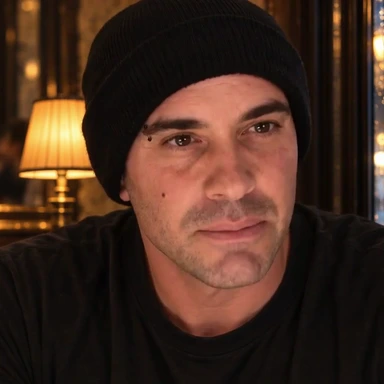
The thinkers’ portraits are real photographs. Tom’s portrait comes from the approved film. Images are displayed with cropping and grayscale styling. The image licenses are retained as listed below.
- Simone de Beauvoir · Moshe Milner / Government Press Office (Israel), Wikimedia Commons · CC BY-SA 3.0
- Viktor Frankl · Prof. Dr. Franz Vesely / Viktor-Frankl-Archiv, Wikimedia Commons; crop by MRCLD · CC BY-SA 3.0 DE
- Erich Fromm · Müller-May / Rainer Funk, Wikimedia Commons; crop by Xabier · CC BY-SA 3.0 DE
- Hartmut Rosa, Jena 2022 · Toter Alter Mann / Wikimedia Commons · CC BY-SA 4.0 · Display crop and grayscale.
.jpg)
.jpg)
.jpg)
