READING ROUTE
From another person’s presence to the possibilities we can reach.
How to use this page: read the sections in order for the simplest route. Each section has a stable deep link into the canonical lecture and evidence map. Scientific uncertainty remains visible; the page never treats a Flow Hijacked hypothesis as an established fact.
PART 01
The Other Enters the Equation
The lecture begins with a simple correction: the nervous system does not operate outside relationship. Other people can change attention, threat, effort and recovery, but the effect depends on who they are and what the relationship predicts.
BNS-P01-S01
Alone Is Not the Default
Human nervous systems do not develop in isolation. From the beginning, other people help shape attention, arousal, threat and recovery, even though each person remains an individual agent.
BNS-P01-S02
Presence Can Change Cost, Not Only Comfort
A supportive person can sometimes make an action feel less costly, not only more pleasant. The same task may require less vigilance or self-control when help is predictable and trusted.
BNS-P01-S03
Buffering Is Conditional
Support is not a dose that works the same way for everyone. Who is present, what they do, the person’s history and the timing can turn the same gesture into help, pressure or threat.
BNS-P01-S04
From Input to Geometry
The key scientific question is not simply whether another person matters, but how they matter. Did they add information, change the starting state, reduce noise, alter attention, or change the system’s effective sensitivity?
PART 02
Attachment as Regulatory History
Attachment is treated as learned regulatory history rather than a permanent type. Repeated experience changes expectations about closeness, help and danger, and those expectations can later be revised.
BNS-P02-S05
Attachment Is Not a Personality Type
Attachment is better understood as a history of expectations about closeness, help and danger than as a fixed personality label. It changes probabilities; it does not determine destiny.
BNS-P02-S06
Priors Written Through Repetition
Repeated experiences teach the nervous system what to expect from other people. Over time those expectations can become fast, automatic and difficult to notice even when the present relationship is different.
BNS-P02-S07
Security, Anxiety and Avoidance Are Tendencies
Security, anxiety and avoidance describe tendencies in how people manage closeness and uncertainty. They are not boxes that explain everything about a person.
BNS-P02-S08
Attachment Can Change Without Being Erased
Relational expectations can change through repeated new experience. Change is usually gradual: old patterns may remain available while new ones become easier to reach.
PART 03
The Body Learns Another Person
The body learns relationships through repeated timing, voice, gaze, touch, distance and repair. Co-regulation is therefore embodied, but it must preserve consent and agency.
BNS-P03-S09
Development Begins in Dyads
Development starts in interaction. Infants and caregivers repeatedly coordinate attention, arousal and recovery, creating a long learning history before a child can regulate with words.
BNS-P03-S10
Voice, Gaze, Touch and Timing
Voice, gaze, touch and timing can all carry regulatory information, but none is universally calming. Meaning depends on consent, familiarity, context and prior learning.
BNS-P03-S11
Mere Presence Is Often Not Enough
Simply having someone nearby is often not enough. Effective support may depend on whether the person feels understood, whether the channel fits, and whether the relationship itself is safe.
BNS-P03-S12
Borrowing Regulation Without Surrendering Agency
Borrowing regulation should increase choice rather than create dependence. The important question is what becomes more reachable for the person after the interaction.
PART 04
Social Buffering and Autonomic Regulation
Stress physiology is socially modulated but multidimensional. No single autonomic measure can stand in for the whole experience of safety or threat.
BNS-P04-S13
Stress Systems Are Socially Modulated
Stress responses are shaped by appraisal, control and social context, not by the event alone. Familiar or trusted people can alter some parts of the response, while other parts may remain unchanged.
BNS-P04-S14
HRV Is Useful - and Easy to Overread
Heart-rate variability can be useful in autonomic research, but it is not a direct meter of safety or a simple reading of sympathetic versus parasympathetic balance.
BNS-P04-S15
Social Baseline as Control Cost
Social Baseline Theory asks whether predictable support can lower expected effort or threat. The idea is useful, but it does not mean every person works better simply because someone else is present.
BNS-P04-S16
When Support Misfires
Support can misfire when it does not fit the state. Advice can feel like criticism, touch can be unwanted, and constant checking can be experienced as surveillance.
PART 05
Chemistry Without Myth
Social chemistry is not a set of one-to-one labels. Oxytocin, dopamine and endogenous opioids participate in context-sensitive systems of salience, learning, motivation and pain.
BNS-P05-S17
Oxytocin Is Not the Trust Hormone
Oxytocin is not a chemical switch for trust or love. Human findings are small, mixed and strongly dependent on context, measurement and the person involved.
BNS-P05-S18
Opioids Modulate Connection; They Do Not Define It
Endogenous opioids contribute to social reward and pain, but blocking them does not erase connection. They are one modulating system among several.
BNS-P05-S19
Social Reward Is Not One Reward
“Social reward” includes very different experiences: intimacy, praise, play, belonging, a child’s message or public approval. Their biology should not be collapsed into one reward signal.
BNS-P05-S20
Neuromodulators as State-Dependent Parameters
Neuromodulators are better thought of as parameters that change sensitivity, learning and salience. The same social event can therefore have different effects in different biological states.
PART 06
Synchrony Is Not Harmony
Synchrony is a measurement of coordination, not a moral score for a relationship. Its meaning changes by modality, context and direction.
BNS-P06-S21
What Synchrony Actually Measures
Synchrony means that signals vary together in some measurable way. It can be behavioral, physiological or neural, and the method used changes what the word actually means.
BNS-P06-S22
Modalities Can Disagree
Two people can be synchronized in one channel and not in another. Breathing, movement, heart activity and neural signals do not have to tell the same story.
BNS-P06-S23
More Synchrony Is Not Better
More synchrony is not automatically healthier. People can synchronize while cooperating, grieving, escalating conflict or becoming distressed together.
BNS-P06-S24
Common Input Is Not Mind-to-Mind Transfer
Shared signals do not prove direct brain-to-brain transfer. Common sights, sounds, movement or task structure can make two brains look coordinated even without direct causal influence between them.
PART 07
Predicting Each Other
People continuously estimate what others mean and what they will do next. Trust and history influence how strongly a signal is weighted.
BNS-P07-S25
The Other Is a Model, Not Only a Stimulus
We do not only react to other people; we predict them. Their face, tone and history help us estimate what is likely to happen next.
BNS-P07-S26
Precision, Trust and the Weight of a Signal
Trust changes how much weight we give a signal. A reassuring sentence from a trusted person may be treated differently from the same sentence spoken by someone associated with danger.
BNS-P07-S27
Active Inference: Strong Language, Incomplete Discrimination
Active inference offers a useful formal language for prediction and action, but many social applications remain theoretical. It should generate tests rather than be treated as a settled explanation.
BNS-P07-S28
Second-Person Neuroscience
Second-person neuroscience studies people while they actually interact, rather than only showing them pictures of social situations. That makes the science more realistic but also harder to control.
PART 08
Multiple Clocks
Relationship unfolds across multiple clocks. Fast arousal, slower learning and long developmental history interact rather than living on one timescale.
BNS-P08-S29
Intrinsic Neural Timescales
Different brain systems integrate information over different timescales. Some respond quickly; others accumulate context over longer windows.
BNS-P08-S30
Fast Arousal, Slow Priors
Arousal can change in seconds while relational expectations change over months or years. A useful model therefore needs fast and slow variables at the same time.
BNS-P08-S31
Coupled Timescales: A Frontier Hypothesis
The idea that two people may need compatible neural timescales is promising but still a frontier hypothesis. Within-brain timescale organization is much better established than between-person matching.
BNS-P08-S32
Temporal Fit in Conversation
Conversation has timing: pauses, overlap, turn-taking and response speed all matter. Temporal fit may influence whether an exchange feels containing, intrusive or disconnected.
PART 09
From Episodes to Learning
A regulated moment is not the same thing as learning. The deeper question is whether repeated interaction changes later expectations, recovery and self-generated regulation.
BNS-P09-S33
Regulation Now Is Not Learning Later
Feeling calmer with someone present does not prove that the nervous system learned to regulate differently later. Immediate buffering and lasting learning are separate questions.
BNS-P09-S34
What Remains When the Partner Leaves?
A strong test of co-regulation asks what remains after the helper leaves. Can the person generalize, recover faster or access more choice later?
BNS-P09-S35
The Fast-Slow Relational Model
Flow Hijacked models fast episodes of arousal and interaction nested inside slower changes in expectations and plasticity. This is a synthesis, not a measured person-level equation.
BNS-P09-S36
Path Dependence and Hysteresis
History matters because systems can be path dependent. Two people can arrive at the same outward state by different histories and therefore respond differently to the next event.
PART 10
Relational Landscapes
Dynamical language helps describe recurring relational states without turning metaphors into measurements. Attractors, metastability, barriers and allostasis are used to ask how transitions become easier or harder.
BNS-P10-S37
Attractors as Models of Recurrence
An attractor is a mathematical way to describe recurrent patterns that a system tends to return to. In relationships this is a model for repeated states, not proof of a literal neural basin.
BNS-P10-S38
Metastability and the Width of the Repertoire
Metastability describes temporary but organized states that can last before the system moves again. A flexible repertoire may matter more than permanent calm.
BNS-P10-S39
Social Allostasis and Shared Set-Points
Repeated conflict or regulation can shift the range in which a dyad usually operates. Social allostasis is a useful model for this slow adaptation, but its set-points should not be treated as directly measured quantities.
BNS-P10-S40
Barrier Height and Returnability
Some transitions are easier than others. “Barrier height” is a way to talk about transition difficulty, not a claim that psychological energy landscapes have already been measured in people.
PART 11
Transient Amplification and Reachability
Stable systems can still amplify particular disturbances for a while. Non-normality, resolvent analysis and controllability provide precise language for sensitivity and reachability, but the relational application is explicitly bounded.
BNS-P11-S41
Stable Does Not Mean Quiet
A system can be stable in the long run and still show large short-lived responses. That distinction is central to understanding transient amplification.
BNS-P11-S42
Non-Normality: A Precise Property, Not a Mood
Non-normality is a precise mathematical property of an operator. It can allow certain directions of disturbance to amplify transiently, but it is not a label for emotional instability.
BNS-P11-S43
Resolvent Gain and Direction-Specific Sensitivity
Resolvent analysis asks which frequencies and directions are most strongly amplified by a local linear system. Applying this directly to relationships is a Flow Hijacked hypothesis, not an established measurement.
BNS-P11-S44
Controllability Means Reachability, Not Control of People
Controllability in network science means reachability under specified inputs and assumptions. It must never be translated into the idea of controlling a person.
PART 12
Co-Dysregulation and Coupled Traps
Coupling can worsen as well as improve regulation. Loneliness, rejection and escalating dyads show why the social field must include maladaptive loops and boundaries.
BNS-P12-S45
Synchronizing Into Distress
Two people can amplify each other’s distress. Co-regulation and co-dysregulation are both possible outcomes of coupling.
BNS-P12-S46
Loneliness as a Recursive State
Loneliness can become self-reinforcing: perceived rejection encourages withdrawal, withdrawal reduces corrective experience, and the next encounter is approached with more threat.
BNS-P12-S47
Rejection Is Not a Single Pain Center
Social rejection recruits distributed brain systems. It is misleading to reduce it to one physical-pain center or to say that social and physical pain are simply the same thing.
BNS-P12-S48
Boundaries Are Part of the Dynamics
Boundaries are regulatory variables too. Distance, refusal, time limits and the right to leave can make a relationship safer and more sustainable.
PART 13
Clinical Ecologies
PTSD, depression, addiction, anxiety and shame all interact with social ecology, but no disorder is reduced to relationship. The purpose is to show reciprocal loops and intervention points.
BNS-P13-S49
PTSD and Social Support: Reciprocity With a Warning Label
PTSD and social support are strongly related, but the direction of causality is not settled. Symptoms can erode support, support can affect symptoms, and statistical models can exaggerate apparent reciprocity.
BNS-P13-S50
Depression, Withdrawal and the Vanishing Social Reward
Depression can reduce the reward and energy available for social contact, which can increase withdrawal and remove useful regulation. This can become a loop rather than a one-way cause.
BNS-P13-S51
Addiction: Belonging, Reward and Competing Fields
Recovery from addiction is shaped by reward, belonging, cues and social ecology. A supportive field can widen alternatives, while a high-risk field can make the old pathway easier to reach.
BNS-P13-S52
Anxiety, Shame and a Narrowed Relational Repertoire
Anxiety and shame can narrow the relational repertoire: speaking, asking, disagreeing or staying present may all become harder. Recovery includes widening those reachable social actions.
PART 14
Therapy as Relational Perturbation
Psychotherapy provides a structured relationship in which prediction, rupture, repair and new action can be practiced. Alliance matters, but it should not be turned into a single magical cause of outcome.
BNS-P14-S53
Alliance Is Robust - and Not a Magic Cause
The therapeutic alliance is reliably associated with outcome, but association is not the same as a single causal mechanism. The relationship can be marker, moderator and contributor at the same time.
BNS-P14-S54
Rupture as a State Transition
A rupture is not automatically treatment failure. It is a moment when the shared regulatory field changes and the relationship may become less predictable or safe.
BNS-P14-S55
Repair as Relational Learning
Repair can become learning when the relationship survives disagreement, misunderstanding or hurt without collapsing into abandonment or coercion.
BNS-P14-S56
The Room Should Not Become the Only Safe State
A therapy room should help capacities become portable. The goal is not to make one relationship the only place where the person can function.
PART 15
Borrowed Gain Geometry
The final part converts the lecture into a research program. Borrowed Gain Geometry asks whether relational context sometimes changes effective response dynamics beyond input, baseline, noise or observation differences.
BNS-P15-S57
The Coupled Nonlinear Model
Borrowed Gain Geometry asks whether relational context can change effective dynamics, not only add social input. This is the lecture’s original Flow Hijacked hypothesis and is explicitly not presented as an established clinical mechanism.
BNS-P15-S58
M0 to M4: Make the Strong Claim Compete
The strong hypothesis must compete against simpler explanations. M0 to M4 separate input changes, baseline or noise changes, gain changes, operator changes and time-varying coupled dynamics.
BNS-P15-S59
What Would Count as Evidence?
Evidence for BGG would require identifiable, preregistered models that predict new data better than simpler alternatives and survive shared-input, measurement and state confounds.
BNS-P15-S60
Ethics, Limits and the Geometry of Freedom
The ethical criterion is wider safe agency, not dependence or forced calm. A useful relational geometry should make more voluntary actions reachable, including saying no, leaving, returning and functioning without one indispensable regulator.
THE COMPLETE DEPTH
The public page is the doorway. The lecture and evidence hold the complete depth.
Move from this page to the full English lecture, the Evidence Map, ASK, Brain Atlas where a referenced network or region exists, and existing Therapy Routes that are genuinely relevant. Do not create a new therapy claim from the dynamical language.
FIRST DEPTH LEVEL
Read the Full Lecture
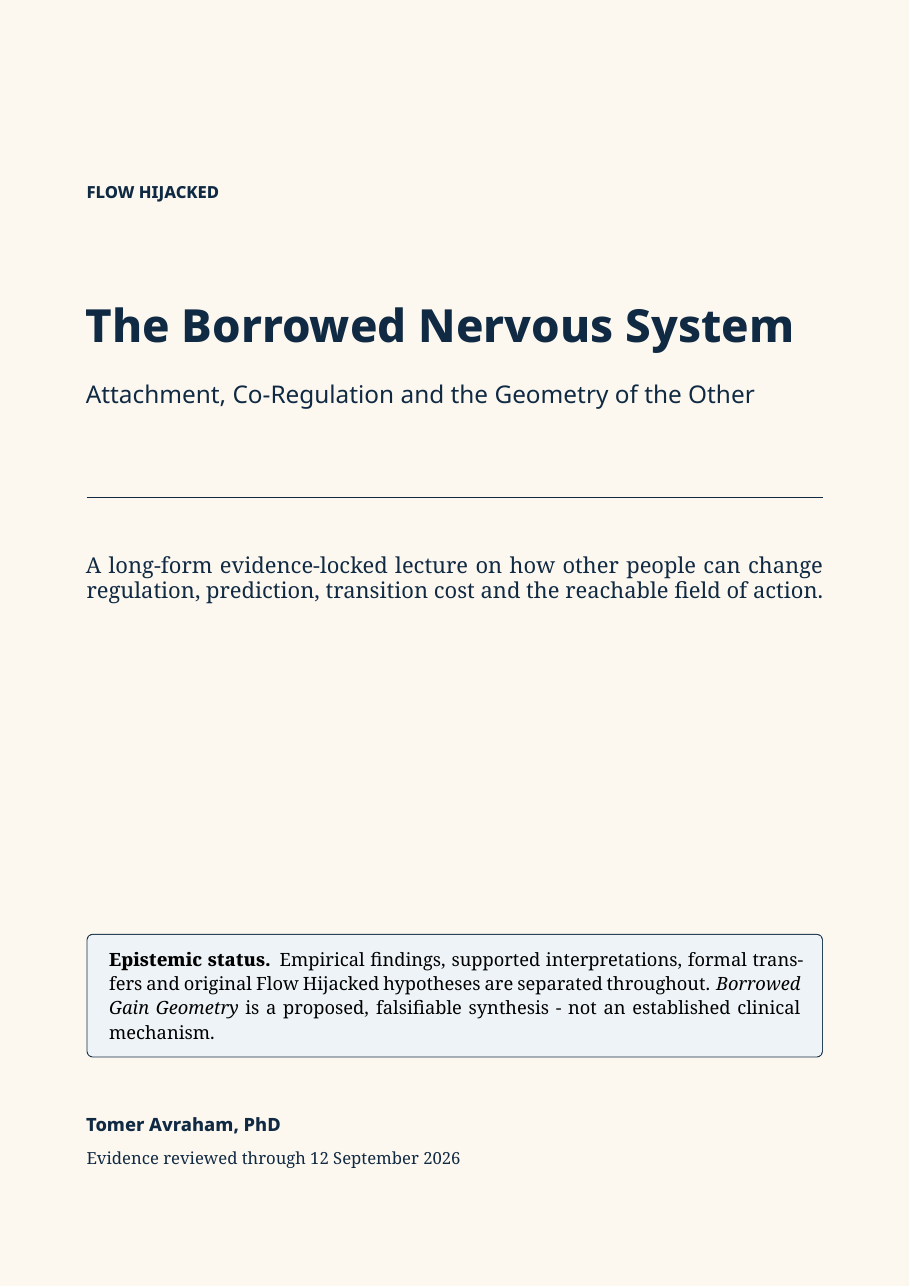
The final expanded 74-page canonical edition, preserving all 60 sections, formal specification and research sources.
SECOND DEPTH LEVEL
Explore the Evidence & Publications
Thirty-two claims mapped to sources, limits, contradictions and a locked numerical policy. BGG remains a falsifiable hypothesis there—not an established clinical mechanism.
ASK FLOW HIJACKED
Begin with an ordinary question. You do not need to know the lecture title.
For example: Why do I calm down when a certain person is with me? Why can support sometimes make me more anxious?
Ask Flow HijackedClinical boundary: This material is psychoeducation and research synthesis. It does not diagnose a person, rank a relationship, mandate contact or touch, alter medication, deny care or replace individualized clinical judgment.