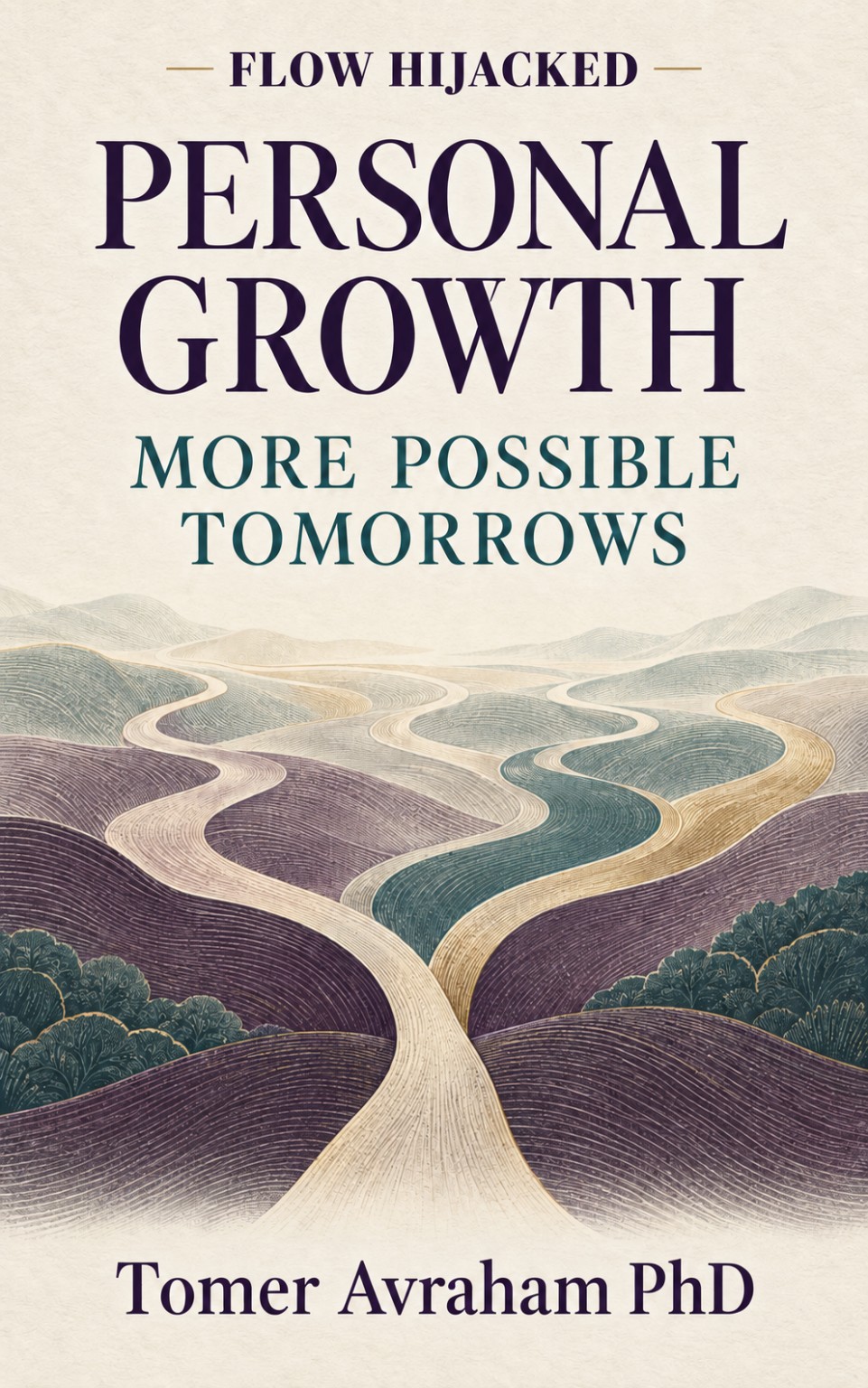
Tomer Avraham PhD, creator of Flow Hijacked, presents a practical guide to understanding the patterns that shape our lives and exploring the conditions that make change possible. Combining scientific ideas, everyday examples and practical tools, he examines how to develop mental flexibility, build sustainable habits and connect a meaningful future to a step you can take today.
The Flow Hijacked lens draws in part on the study of complex nonlinear dynamical systems, alongside psychology and neuroscience. It examines how bodily state, attention, memory, expectations, relationships and surroundings influence one another over time. Through this perspective, the book explores how feedback loops sustain familiar patterns, why greater effort does not always produce proportionally greater change, and how the effect of an action depends on when, where and in what state it becomes possible.
These ideas become practical questions. What keeps a particular pattern going? What makes another response difficult to reach? Could a change in the task, the environment or the support available create an opening? The book follows these questions into the decisions, frustrations and possibilities of ordinary life.
Across 39 chapters in ten parts, it brings together 21 practices and protocols addressing:
Attention, focus and mental flexibility
Motivation, getting started and building habits
Identity, self-compassion and the capacity to act
Hope, meaning and possible futures
Memory, loss and adapting to a changed world
Relationships, belonging and the conditions around us
Sustaining change through demanding periods and setbacks
For example, The Five Minute Threshold offers a manageable entrance into a task that feels difficult to begin. Future State Bridge connects a valued possibility to a feasible action in the present. Friction Flip examines how adjusting a cue or obstacle could make a desired action easier to reach. Other practices explore moving between focused attention and open exploration, and responding to a mistake with enough compassion to make responsibility and repair possible.
With 218 references, the book explains the research behind its ideas while distinguishing established findings, conceptual models and Flow Hijacked’s own synthesis. Readers are invited to adapt the practices to their circumstances, recognize their limits and consider when rest, practical support or a different goal would make more sense.
Personal Growth: More Possible Tomorrows is about expanding what becomes possible in a life: the actions you can take, the patterns you can revise, the support you can reach and the futures you can begin to make real.
Choose one thing that fits this moment. There is no list to complete.
I cannot start: The Five Minute Threshold
One option for this moment
The Five Minute Threshold
A whole task can be hard to enter even when you care about it. Choose a first contact small enough to try, with a real right to stop.
Choose one visible first action, such as reading the first question. Agree to do only that small unit, or use up to five minutes as a ceiling. Begin only if it fits your capacity and is safe.
Only if usefulAt the agreed stopping point, choose whether to continue, make the task smaller or stop. If useful, leave one clear note about where to return.
Then notice Did you reach the task, or discover a condition that needs to change? Include any later cost.
Stop for pain, exhaustion or worsening symptoms, including later worsening. Do not override care or force unsafe work. If basic care needs attention, choose the minimum viable day instead.
If the old plan exceeds your current capacity
The minimum viable day
A smaller day can protect continuity without requiring performance.
Protect the basic need most at risk and remove or postpone one unnecessary demand. Ask for or accept one useful form of support if available.
Only if it fits, keep at most one small action that still matters. This action can be omitted.
Do not shrink medication, essential care or food to fit a smaller plan. No movement or increased activity is required. Inability to meet basic needs or worsening symptoms calls for more help.
This is a practical adaptation from the book. Research supports particular studied components and approaches; it does not validate this brief practice as a treatment package.
Related treatments can help with procrastination and depression. They do not establish the effect of this brief practice. Five minutes is a practical ceiling, not a proven therapeutic dose.
Behavioral activation evidence concerns complete treatments for adult depression, with certainty varying by comparison.
The lens of Flow Hijacked
What has become hard to reach?
‘What is wrong with me?’ can become a different question: ‘What state am I in, what has become difficult to reach, and what is shaping the transition?’ That question makes room for body, surroundings, relationships and history, alongside choice and responsibility.
What growth can include
In this book, personal growth means gradually widening your capacity to reach meaningful states, sustain them, leave them when needed, revise a direction, recover from difficulty, integrate experience and become something new within real constraints. It can include learning, friendship, love, creativity, curiosity or rest. It can also mean receiving support or letting an old ambition end. The direction is a more livable life, with choices you can use and room to enjoy what is already here.
A conceptual sketch, not a brain map. Conditions change the paths available to us. Rest and support can be part of the route.
These six ideas connect the book's questions. Each keeps its scientific meaning separate from the way Flow Hijacked uses it to understand an ordinary life.
01AttractorsFamiliar patterns can pull us back, from checking a feed to seeking a friend. Today's conditions and past experience shape which routes feel available.
Some patterns become easy to return to: opening the feed whenever work becomes uncertain, or reaching for a trusted friend after a difficult day. What happens next depends partly on today's conditions and the path that brought you here. In dynamical systems, an attractor is a pattern toward which trajectories converge from particular starting conditions. Flow Hijacked borrows this idea to describe familiar ways of thinking, feeling and acting. It is an explanatory analogy at the scale of a life; a recurring habit does not show that a person's neural attractor has been measured.
02Transition costThe hard part may be entering the task. Effort, uncertainty, bodily capacity and practical conditions all belong in the question of what would help.
A small task can carry effort, uncertainty, threat or practical demands. Before calling a clinic, you may need privacy, a number, enough energy and someone to watch the children. Sleep, pain and earlier experiences can change what the same call costs today. In Flow Hijacked, transition cost brings these obstacles into view so the next response can fit. It does not assign them a common unit or equate ordinary effort with energy calculated in a neural control model. Sometimes the useful change is support, rest or a different arrangement.
03State-space compressionA busy life can still feel short of real choices. The book asks which meaningful possibilities have narrowed and what could make them accessible.
A week can contain many tasks and very few usable choices. After work, you can imagine seeing a friend or making something, yet neither feels reachable; only work and recovery from work seem available. Flow Hijacked calls this narrowing state-space compression. It asks which meaningful possibilities have become difficult to enter and what might reopen them. This is the book's synthesis, not a diagnosis or a measured reduction in neural state space. Exhaustion, grief, illness and missing money can narrow access for different reasons and require different responses.
04Adaptive MobilityBeing able to begin, stay, leave and return as circumstances change. The book's proposed capacity includes steady commitments, recovery and help from other people.
You begin a piece of work, stay with it long enough to learn, then stop when a commitment needs your attention. After an interruption, you find a workable return. Adaptive Mobility is Flow Hijacked's proposed name for that wider capacity to reach, sustain, leave and revise useful states and commitments. It includes recovery, dependable routines and help from others. The question is whether you have room to respond appropriately as circumstances change. It is not a validated scale, a demand for constant switching or a claim that more options always mean a better life.
05Future State AccessibilityWanting a future, picturing it and being able to reach it are different questions. The book asks what enables entry, staying and leaving.
An evening course may be easy to picture and still impossible to attend. Do you want it? Does it seem credible? Can you afford the fee, get there, stay and leave when you need to? Future State Accessibility separates those questions instead of treating imagination as access. It is Flow Hijacked's organizing construct, informed by research on future thinking and planning, rather than a validated score. The next step could be a question about the timetable, a request for assistance or a different goal. A vivid scene cannot supply missing transport or another person's consent.
06CouplingWhat you can do changes with other people and your surroundings. Their responses can open or narrow options, without making everyone's power or responsibility equal.
A phone call becomes possible when a friend sits beside you; an argument escalates as each response changes the next. Coupling concerns how parts of a situation influence one another, across bodies, people and environments. Flow Hijacked asks what becomes more reachable, and for whom. Small changes can sometimes have disproportionate effects when conditions interact. That does not prove a nonlinear mechanism: temporary amplification also occurs in some linear models. These everyday scenes illustrate the synthesis; they do not measure neural coupling. Influence does not imply equal power, consent or shared blame.
Research addresses learning, habits, sleep, planning and relationships, among other subjects. Bringing them together through this lens is Flow Hijacked synthesis. Adaptive Mobility and Future State Accessibility are not validated clinical measures.
One journey, ten movements
From getting stuck to a life with room
This journey connects the book’s 39 chapters. Read through, enter where something matters, or stay with the practice above. There is no sequence to complete.
Mara and the everyday scenes that follow are illustrative, not research case reports.
01
Why We Get Stuck
At work, Mara is the person who can make a difficult conversation possible. At home, still wearing her shoes, she snaps at a question about dinner. The contrast seems to settle something unpleasant about her character. But the evening contains things the meeting did not: several people need her, the working day has no clear ending, and nobody has agreed who will carry the next hour. Her reply still needs an apology. Understanding the conditions could also change what happens tomorrow, before another apology becomes necessary.
What changes when we examine the conditions of a difficult moment as carefully as we judge the person in it?
Through the lens · Flow Hijacked
The book begins with a person in a situation. What feels available depends partly on bodily state, learned expectations, surrounding demands and other people. Its central proposal is to examine how a useful possibility becomes reachable, stays available and can eventually be left or revised. This does not measure a hidden landscape inside Mara. It gives her more specific questions than a verdict about patience.
Three ideas to carry further
A state has conditions
A change in sleep, privacy or workload can alter what the same person can manage. Sleep research gives this idea empirical weight, while leaving the individual response uncertain. The relevant question is which conditions changed in this particular moment. [1]
Responsibility includes preparation
An explanation can enlarge responsibility. Alongside acknowledging a hurtful reply, Mara can negotiate the evening workload or protect a short arrival interval. These changes do not guarantee patience. They address parts of the sequence that another promise to improve leaves untouched.
A possibility needs an entrance
Knowing that rest or an honest conversation would help does not make either immediately accessible. Habit and context research supports examining the route into an action. The book extends that question to support, recovery and the permission to revise a demand. [2]
Once the question becomes more specific, the next response can become smaller. Mara does not need an entire new personality tonight. She needs to recognize what is blocked and choose a response that fits it. ↓
02
Change State Now
The laptop is open, and the message Mara wants to send is still blank. She could start writing. She could also spend twenty minutes finding a better method for starting. Beside the keyboard sits the phone she checks whenever the sentence begins to feel risky. This time she names the immediate difficulty: she does not know how to acknowledge the hurt without promising that nothing difficult will ever happen again. That gives the next few minutes a smaller job. Write one honest opening, then decide what it needs.
What is difficult to reach right now, and what small change actually fits that difficulty?
Through the lens · Flow Hijacked
A useful response begins by distinguishing the blocked movement. Attention may need a place to return. Shame may be obstructing repair. A task may need a clearer entrance, or the room may keep inviting a familiar detour. The five flagship practices offer different starting points within one revisable loop. They borrow from existing research, but their combined forms and routing have not been validated as treatments.
Three ideas to carry further
Give the next moment one job
Choose a concrete movement rather than a total improvement goal. Reading one paragraph, putting work away and asking for company are different actions. Naming one helps reveal whether the barrier is uncertainty, anticipated pain, missing capacity or a practical condition.
Let a tool have an exit
A bounded start is an invitation to gather information, with permission to stop. Five minutes is a practical boundary, not a proven therapeutic dose. If the action exposes a missing resource or worsening symptoms, the next response should take that information seriously. [1]
Review what became possible
After a small attempt, ask what became possible and at what cost. A completed sentence, a clearer obstacle and a needed rest are different outcomes. Keep those differences visible, then keep, revise or put down the tool instead of repeating it automatically.
A small response can change the next moment without making every difficult thought disappear. Mara may write a useful sentence and still hear yesterday’s argument. We need to understand what a returning thought is doing. ↓
03
Attention, Thought and Mental Mobility
While the kettle heats, yesterday’s conversation returns. At first, Mara remembers a question she interrupted. That detail could change the apology. Then the thought changes its demand. Why does she always do this? What does it reveal about who she really is? The kettle clicks off. Several minutes later, no new detail has appeared, but the matter feels more urgent. The same memory has moved from supplying useful information to keeping a verdict in place. It may return again even after she notices the difference.
Is this thought helping me learn or respond, and can I leave it when another part of life needs attention?
Through the lens · Flow Hijacked
The book examines a thought’s place in the unfolding situation. Content matters, but so do repetition, new information and the responses the thought permits. An uncomfortable memory can support a repair. A seemingly responsible analysis can make action increasingly conditional on impossible certainty. Mental mobility includes sustained attention, wandering and return. It does not require permanent calm, constant switching or complete control over what comes to mind.
Three ideas to carry further
Look for a question that can receive an answer
A question about what was said may lead to a conversation. A demand to prove that you will never fail cannot be completed that way. Turning a loop into a specific question can clarify whether inquiry, action, support or a pause is now useful. [1]
An open interval needs a way back
After preparation, setting a problem aside can improve performance on some creative tasks. The result depends on the task and conditions, and no ideal break is established. An interval may also be worthwhile simply because it contains pleasure, rest or ordinary life. [2]
Distance should leave contact possible
A less immersed viewpoint may make reflection easier, but reduced emotion does not prove greater truth. Keep the facts, the other person and the possibility of response in view. If inward attention becomes overwhelming, an ordinary external reference or human company may fit better. [3]
The conversation is clearer now, and the next useful action has a name. Yet the message can remain unsent. Attention and understanding have changed the situation. Beginning an action still has conditions of its own. ↓
04
Action
Mara has found the sentence she wants to send. She opens the message window, then checks the weather. The change of subject is almost too small to notice. She still wants the conversation. She is no longer convinced that everything is ruined. Yet understanding has not moved her fingers through the final step. Perhaps sending seems to commit her to an immediate reply she cannot manage. Perhaps the window is full of other messages. A sincere intention can leave the entrance to an action surprisingly undefined.
What has to be true for this intended action to become possible here?
Through the lens · Flow Hijacked
An intention reaches the present through a sequence of conditions. A recognizable occasion, a clear response, access to what is needed and an acceptable cost all matter. The action chapters follow that sequence through starting, repetition, feedback and revision. Their contribution is to keep the whole route visible. An easier entrance has value when it serves a worthwhile direction and leaves room for recovery and change.
Three ideas to carry further
Let the plan meet an actual occasion
A cue linked to a feasible response can help a plan become actionable. The occasion must really exist: an office must be open, privacy available, a needed resource within reach. Planning evidence does not make these practical dependencies disappear. [1]
A routine belongs to a setting
Repeated actions often become easier in recurring circumstances. When those circumstances change, the old cue may no longer lead anywhere useful. Revising the arrangement can be more informative than demanding a stronger identity, and no fixed day certifies that a habit is complete. [2]
Let results inform the direction
Feedback can show what needs practice, what requires rest and what no longer deserves the same commitment. Persistence and leaving both have consequences. Goal adjustment research supports taking the distinction seriously without providing a validated rule for a particular person’s decision. [3]
Eventually the message is sent. What happens next includes another quiet decision: whether the action is allowed to count. A person can change what they do while protecting an old account of who they are. ↓
05
The Self You Are Building
By evening, Mara has found reasons the message should not count. It was short. It took too long. A friend helped her choose the words. Someone who was truly good at difficult conversations would not have needed all that preparation. The facts of the action are unchanged, but their place in her story has narrowed. Failure can enter as evidence. Success has to pass a different examination. If every useful exception is dismissed this way, tomorrow’s choices will be made inside an account that cannot learn.
Can my account of myself admit relevant new evidence without requiring a flattering story?
Through the lens · Flow Hijacked
Actions do not speak for themselves. Their meaning is shaped by expectations, roles and the responses of other people. The book proposes treating identity as an account that can be examined and revised. The aim is enough accuracy to allow a next choice, including reliance on help. Narrative research informs this approach, but it does not prove that changing a sentence changes a life. A revised account still needs to meet actual actions, circumstances and relationships.
Three ideas to carry further
Keep the scale of the evidence
One completed conversation does not settle who you are, but it can qualify the claim that you never manage one. Describe what happened, under which conditions and with what help. This preserves both the achievement and the information needed for a future attempt.
A role can make room or take it
Being reliable, caring or capable may express something deeply valued. The same role can accumulate demands that leave other needs without a place. Examine one arrangement and its costs before turning the whole identity into something that must be defended or abandoned.
Confidence is allowed to learn
Belief in capability can matter, and previous performance is also associated with later confidence. Instruction, practice and opportunity may therefore belong beside encouragement. A useful account leaves room for learning a skill or changing access instead of making confidence another prerequisite you must supply alone. [2]
An old description may loosen enough to admit a possibility: perhaps learning, connection or a different role still belongs in this life. That permission matters. The possibility also needs a route from tomorrow into an ordinary evening. ↓
06
The Future
The evening course is on Mara’s calendar. She can explain why she wants it: something to learn, people to meet, a part of the week that belongs to an interest of her own. At seven, however, the dishes are here and the tiredness is here. The class is an unfamiliar room on another evening. She opens the timetable and discovers that the first useful question is about transport home. Imagining herself as a student had left out the ordinary journey that being a student would require. That detail could decide whether she returns after the first class.
What would connect this worthwhile future to the actual conditions of an ordinary day?
Through the lens · Flow Hijacked
A future needs more than approval. It must have enough detail to be considered, enough credibility to deserve effort and a route through present constraints. Future State Accessibility is the book’s proposal for keeping these different questions together. It includes practical dependencies and shared futures, while allowing the horizon to shorten. A useful tomorrow may contain reliable care or an unhurried visit rather than a new achievement.
Three ideas to carry further
Picture the ordinary beginning
A scene with a time, a place and an action can make a future easier to examine. Experimental future thinking can change some delayed reward choices, but that does not prove lasting life change. Include the bus ride and the first uncertain conversation. [1]
Let the obstacle become specific
An obstacle can point to a next question or a request. It may require childcare, money, permission or a different timetable. Planning research supports modest average benefits under studied conditions. It does not turn a missing resource into a mistaken attitude. [2]
Hope can change what it asks for
A desired outcome may become unavailable while something valuable remains possible. Changing the horizon can preserve participation without pretending the loss is good. Hope is allowed to be uncertain, shared with another person or expressed through a practical act of care. [3]
The route to the classroom is clearer. But entering the room can still awaken an expectation learned somewhere else. Making tomorrow plausible brings us to another question: what happens when the past arrives before the present can speak? ↓
07
When the Past Is Still Acting
At the first class, Mara asks a question. The teacher pauses before answering, and the room suddenly feels familiar in an unpleasant way. Years earlier, a pause like that had often preceded ridicule. She starts explaining herself before anyone has criticized her. Then the teacher asks her to repeat the last word because a chair scraped across the floor. The present has offered a different explanation. Taking it in may still be difficult. A learned expectation can arrive quickly, and one ordinary correction need not change it all at once. It may still feel difficult next time.
What is history helping me recognize, and what does this present situation still need to reveal?
Through the lens · Flow Hijacked
History can remain active through memories, expectations, bodily responses and habits of protection. The book asks whether those responses still describe the situation accurately enough to guide the next move. Sometimes an old warning remains relevant. Sometimes current evidence deserves room to alter it. Updating is a practical possibility and a scientific question, but a changed response does not demonstrate that a memory was erased or biologically reconsolidated.
Three ideas to carry further
A reaction needs context
A strong response is real without being a complete explanation of its cause. Present danger, learned expectations, illness and exhaustion can each matter. Noticing a difference now must never require inventing safety, testing a dangerous person or dismissing a new physical symptom.
Writing should have a purpose
A page might clarify a concern or prepare a conversation. Repeated disclosure can also intensify distress, and expressive writing findings are modest and mixed. Choose a manageable purpose and stop if the exercise becomes compulsive or repeatedly worsens sleep, intrusions or daily functioning. [1][4]
Different care carries different evidence
Private reflection, supported clinical writing and established trauma treatments are different offers. Evidence for one cannot supply efficacy or a mechanism for another. Persistent disabling symptoms deserve appropriate assessment, and optional exercises should not become a condition for receiving help. [3]
In recently separated adults, the subgroup already strongly seeking meaning had worse emotional outcomes after expressive writing than after control writing over follow up. The result does not establish that emotional writing generally causes harm.
Sometimes the present offers a reassuring difference. Sometimes it contains a loss that no new interpretation can undo. Grief asks us to face changed reality while making room for a relationship that still matters. ↓
08
Loss, Grief and Reality Updating
Something happens that they would have found funny, and you reach for the phone. Their name is where it has always been. Then the fact of the death returns. You knew it when you woke, yet the day has briefly arranged itself around sharing this small event with them. A relationship had given ordinary news a destination. Now the news still arrives. Perhaps you tell someone else, perhaps you keep it, perhaps you simply miss them. None of these responses has to settle what the relationship means. Nor must it prove that you have learned how to live with the change.
What can remain meaningful when the familiar way of being together is no longer possible?
Through the lens · Flow Hijacked
This is a different kind of updating. The loss may be an irreversible fact, while attachment, memory and influence remain part of the person’s life. The book distinguishes continuing significance from the former availability of an interaction. That distinction offers room for choices about remembrance and ordinary activity. It is a synthesis informed by grief research, not a demand to preserve a bond or a tested treatment for grief. Its remaining forms can also be changed or declined.
Three ideas to carry further
Knowing and reaching can coexist
A familiar gesture toward someone who died need not mean that the fact has been denied. Learning accounts of grief help explain why knowledge and expectation can differ. They remain models, and they do not reduce love or yearning to one neural mechanism. [1]
A bond may take different forms
Remembering may comfort on one day and become too much on another. Continuing bonds can also be unwanted or complicated by harm. The evidence does not require one correct form of connection, a positive legacy, forgiveness or a daily ritual. [2]
Company and treatment answer different needs
Someone sitting beside you can help with an ordinary task. Persistent, disabling grief may need clinical assessment and treatment with its own evidence. Neither support nor treatment requires sadness to disappear, and a calendar alone cannot decide whether a person is coping well. [3]
One ordinary task may become possible because somebody stays beside you. The significance of that company extends beyond grief. It asks us to notice how much of apparently personal capacity is carried between people. ↓
09
Other People Are Part of the System
The letter has been on the table for three days. You understand what it concerns and know the number to call. A friend arrives, and after tea you mention it. They ask whether advice would help. You ask for something simpler: could they sit nearby while you make the call? The number has not changed. You still dislike the conversation. Now, though, somebody can listen afterward or help untangle a confusing answer. You dial, and the action belongs to you without having to happen entirely alone. The help does not have to disappear for what happened to count.
What kind of company or practical change would make participation possible while preserving choice?
Through the lens · Flow Hijacked
An action is partly shaped by the relationship in which it occurs. Other people can provide time, information, safety and a way to recover from confusion. They can also make disagreement or asking for help costly. The book brings these interactions into its account of change. Useful support is examined through participation, consent and room to revise, without making independence the universal destination.
Three ideas to carry further
Ask for the kind of help you mean
Advice, company and practical assistance do different things. A specific request can make the desired role clearer, while leaving the other person free to answer honestly. Social buffering experiments inform the background, but they do not establish the effectiveness of a particular request script. [1]
Access belongs inside the explanation
Childcare, transport, predictable work and money can determine whether an intention has somewhere to go. Evidence about material interventions supports taking resources seriously. Asking clearly cannot guarantee that a resource exists, and an institution’s refusal does not measure a person’s commitment. [2]
Leave room for quiet and disagreement
Chosen solitude can restore room, while unwanted isolation can hurt. A supportive relationship also needs space for disagreement and changing needs. Neither contact counts nor immediate calm can settle what helps. Notice the quality of the arrangement and its consequences over time. [3]
Even a good arrangement can change. A friend moves, care needs grow, a job expands or a familiar routine becomes too expensive. Growth needs a way to survive altered conditions without turning every interruption into a verdict. ↓
10
Growth That Survives Real Life
For months, the morning arrangement worked. The clothes were ready, the route was familiar and the hour belonged to exercise. Then your father came home from hospital. That hour filled with prescriptions, broken sleep and calls to find out whether the person helping would arrive. After a week, you stopped putting the clothes out. The explanation came quickly: you had lost your discipline. But the same hour on the clock was no longer the same hour in your life. Returning would require an account of what had changed. Who could share the load, and what would restoring the old routine displace?
What is worth carrying forward, and what must change for it to remain livable?
Through the lens · Flow Hijacked
Growth must remain responsive to the life carrying it. The book’s proposed criterion includes entering a useful activity, staying where commitment matters, recovering after difficulty and revising a route that no longer fits. Outcomes and costs belong in the same account. A practical review asks what became possible and what it required, then ends. Neither uninterrupted performance nor continual examination is the destination.
Three ideas to carry further
Let the day fit current capacity
A minimum viable day begins with necessary care and a feasible expectation. Rest may require removing a demand or arranging coverage. Movement is optional and must fit health and care needs. Persistent symptoms or serious deterioration deserve help beyond another smaller plan. [1]
A return can have a different shape
An interruption does not by itself erase previous learning. It may reveal changed cues, demands or goals. Repair what needs repair, and examine whether to persist, redesign, pause or leave. Serious clinical deterioration or a dangerous return to substance use needs its own response. [2]
Let the review give life back
Notice what changed, distinguish the obstacle, choose a fitting response and review its cost. This is the same loop introduced earlier, used across a longer interval. Monitoring can help selected goals, but more measurement is not automatically more understanding. The review needs permission to end. [3][4]
The next entrance may be an unfinished message, a chair, a conversation or an hour you can finally share. Return to the part that meets it. The rest of the book can wait while life continues.
A way back
Four questions for a next move
Notice
What has changed, and what is hard to reach?
Distinguish
What seems to be blocking it? Is this a passing difficulty or a pattern that needs more help?
Respond
What small change fits—an action, recovery, redesign, support or release?
Review
What became possible, at what cost? Keep, revise or put down the tool.
A sentence may be enough. No record, score or daily review is required. These questions organize a choice; they do not diagnose a condition or prove what caused a change.
This is a bilingual gateway to Personal Growth: More Possible Tomorrows by Tomer Avraham, now available in complete English and Hebrew editions. The reading journey draws on its 39 chapters, Protocol Atlas, Evidence Map and Contradiction Ledger, connecting questions, evidence and tools for ordinary life.
Sources and limits sit beside the ideas and practices they concern. Scientific appraisal is inherited from the book and its audits; this page does not represent a new literature review. Evidence for a studied component does not validate the shortened practice or the overall lens as a treatment package.
The practices are invitations to learn and choose. Persistent difficulty, impaired functioning or danger may need appropriate support and care. You do not have to prove that you tried enough before asking for help.