Guided reading
Cannabis, one clear step at a time.
Seven short parts, written for people rather than specialists. Read them in order and the picture will build gradually. The complete scientific lectures are waiting at the end.
Part I
Cannabis is not one thing
Cannabis is a broad name for a family of plants and products. Flower, hash, oil, an edible and a concentrate can all carry the same label while creating very different exposures in the body and brain.
The mix matters. THC accounts for most of the intoxication. CBD behaves differently, but it is not a simple antidote to THC and it does not make every product safe. Labels and familiar names do not always tell the whole chemical story.
One word can hide many different exposures.
So the useful question is not only, ‘Is cannabis good or bad?’ It is: which product, how strong, how much, by which route, for whom, and at what point in life?
Part II
The brain already has a cannabinoid system
The body makes its own cannabinoid-like signals. They help fine-tune communication between cells and take part in memory, appetite, pain, stress, sleep and many other functions.
THC enters this existing system. It does not press one isolated button. It changes signalling across a wide network, which is why the experience can include altered time, attention, memory, appetite, movement, calm or fear.
Through the Flow Hijacked lens, this matters because the brain is adaptive and nonlinear. A change that is easily absorbed in one state may have a much larger effect in another. The result depends on the signal and on the system receiving it.
Part III
How it enters changes the clock
Inhaled cannabis reaches the brain quickly. An edible usually begins later, varies more from person to person and can last much longer. That delay can make it easy to think that nothing is happening while the first amount is still being absorbed.
Strength is not the same as dose, but it changes how much THC can be delivered in a small amount of product. Modern high-potency concentrates can therefore leave less room for error than weaker flower.
The route writes the clock, and the clock changes the experience.
Amount, speed, frequency and repetition all matter. Alcohol, nicotine, prescription medicines, sleep loss and driving add separate questions that the word ‘cannabis’ alone cannot answer.
Part IV
The same amount can land differently
Age, sleep, stress, genetics, previous experience, tolerance, physical health and the setting can all change what follows. Even the same person may respond differently on a calm afternoon and after two sleepless nights.
Research gives stronger reason for caution with frequent high-THC use during adolescence and for people with a personal or family vulnerability to psychosis or bipolar disorder. Anxiety, panic and mood symptoms also deserve attention, but they are not all the same question.
Vulnerability is not a type of person. It is a changing relationship.
These findings describe changes in probability, not a verdict on a person. Vulnerability is not weakness, and risk is not destiny. It is a relationship between a particular exposure and a living system at a particular time.
Part V
Relief can be real and still be complicated
People may genuinely experience relief from pain, nausea, poor appetite, tension, sleeplessness or an inner world that feels too loud. Taking that relief seriously is part of understanding the person.
Short-term relief and longer-term cost can exist together. With repetition, tolerance can grow, stopping can become uncomfortable, and the substance can begin to carry more of the work of sleep, calm or emotional escape.
Medical evidence is strongest for particular standardized cannabinoid medicines and specific conditions. That evidence does not automatically transfer to every flower, oil, dose or retail promise. A treatment claim needs its own product, outcome and quality of evidence.
Part VI
When use begins to narrow life
A useful option can slowly become a governing routine. Warning signs include using more than planned, spending a great deal of time around use or recovery, finding it hard to cut down, and continuing while work, relationships, memory or mental health are being harmed.
Cannabis Use Disorder is a clinical description, not a moral judgement. It can be mild or severe, and it does not erase the reasons a person began using. Relief, habit, cues, withdrawal and learning can all become part of the same loop.
A choice can remain visible while becoming harder and harder to reach.
The Flow Hijacked view asks what the loop is doing now: which immediate state has become easiest to reach, which future options have lost emotional weight, and what support could make another path available again.
Part VII
Reduce harm and keep the whole picture
Risk can be reduced without pretending that it can be removed. Driving while impaired, mixing substances, unknown products, very high THC exposure and taking more before a delayed edible has taken effect all deserve particular caution.
Pregnancy, breastfeeding, heart conditions, prescription medicines and a history of serious mental-health symptoms call for individual clinical guidance rather than a general internet rule.
Severe confusion, chest pain, loss of consciousness, persistent vomiting, suicidal intent or psychotic symptoms require urgent professional assessment. Asking for help is a safety decision, not an admission of failure.
You do not need to settle every cultural argument about cannabis to look honestly at one person, one product and one pattern of use. That is where a useful conversation begins.
Ready to go deeper?
The simple map ends here. The full evidence begins next.
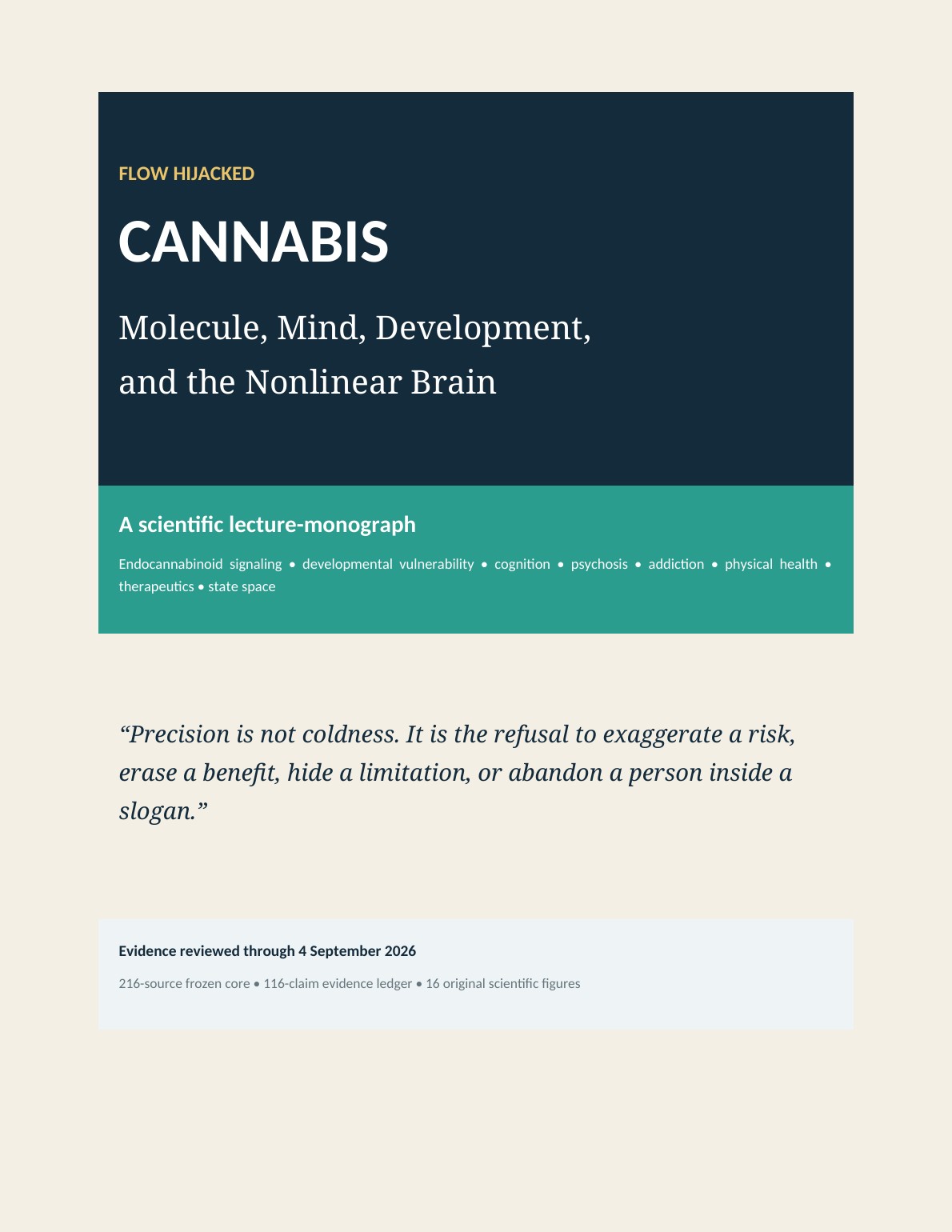
The two lectures below follow the same path in much greater depth, with 216 sources, a claim-by-claim evidence ledger and 16 original scientific figures. Choose the language that is easiest for you.
Continue to the full lectures