Guided reading
After danger, one clear step at a time.
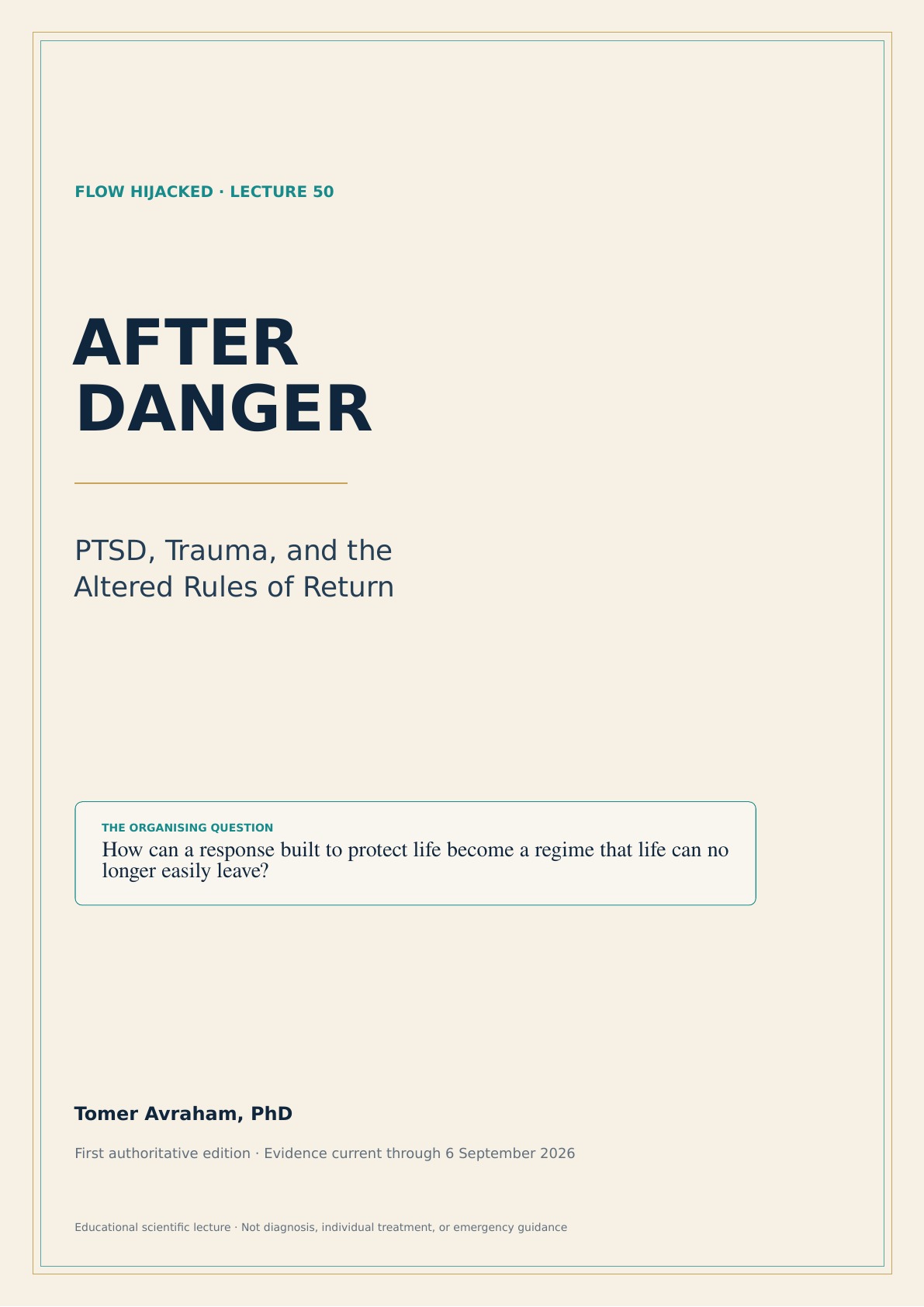
Eight short parts, written for people rather than specialists. They begin with lived experience, move through memory, body and treatment, and lead into the two complete scientific lectures at the end.
Part I
The event can end before the alarm does
A traumatic event can be over while the person’s system still prepares for it to happen again. A sound, smell, message, silence or bodily sensation may bring the danger close before there has been time to think. This is not a decision, a failure of will or proof of weakness.
Strong reactions after trauma are common, and many ease with time and support. PTSD is not another name for every painful response. It describes a particular pattern of symptoms that persists, causes distress or limits life, and is assessed in its full clinical context.
The calendar may say ‘after’ before the nervous system can live there.
Grief, anxiety, depression, acute stress, moral injury and dissociation can overlap with PTSD, but they are not interchangeable. A diagnosis can help organize care; it should never replace the person’s whole story.
Part II
Threat can arrive before explanation
The systems that protect us are built for speed. They can change heart rate, breathing, muscle tension, attention and movement before deliberate thought has caught up. That speed is useful in danger. It becomes costly when yesterday’s rule keeps governing today.
Some people are pulled into unwanted memories, nightmares or a sense that the event is happening again. Some avoid places, conversations, sensations or sleep. Others feel numb, detached, watchful, easily startled or unable to settle. The pattern can move between activation and shutdown rather than staying in one state.
The Flow Hijacked lens asks which cues now carry unusual power, which defensive state becomes reachable too quickly, and what makes a safer state difficult to hold. It describes changing conditions, not a fixed kind of person.
Part III
Memory is not a video file
Traumatic memory is not simply a recording stored in one place. It is rebuilt through fragments of image, sound, body sensation, meaning and context. A memory can feel vividly present while important parts remain unclear, or be difficult to describe while the body reacts strongly.
The brain can learn both danger and safety. The difficulty is that safety learning is often tied to context: something learned in a quiet room may be harder to reach at night, in a crowd or during an unexpected sound. Knowing that the event is over and feeling safe enough to act can therefore separate.
Knowing that the danger is over is real knowledge. Sometimes the rest of the system needs new learning too.
Memory, attention, prediction and bodily state work together. No single region explains the whole experience, and no brain image can read one person’s trauma story on its own.
Part IV
Getting into threat and getting back are different movements
One person may enter a defensive state very quickly and return once the cue is understood. Another may enter less often but take much longer to settle. A symptom score can look similar while the movement underneath it is different.
Flow Hijacked calls this possible difference Threat-State Return Asymmetry. The simple idea is that entry into threat and return to safer engagement do not have to change by the same amount. Treatment might therefore need to work on recognition, entry, return or the conditions that support return—not on one universal target.
The way into a state does not automatically tell us the way out.
This is a testable research proposal, not an established fact about PTSD, not a diagnosis and not proof that a person’s brain is dynamically rigid. Simpler explanations may turn out to predict recovery just as well or better.
Part V
The body is part of the story, not proof of one theory
Trauma can be lived through sleep, breathing, heartbeat, pain, tension, startle, exhaustion, numbness and the sense of what is happening inside the body. These experiences are real. They do not mean that every symptom has one cause or that a memory is literally stored in a muscle.
The amygdala, hippocampus, prefrontal cortex, insula, attention and salience networks, autonomic regulation, stress hormones and sleep can all matter. They act as a changing system. The phrase ‘fear centre’ is too small for that system and too simple for a human life.
Bessel van der Kolk and The Body Keeps the Score helped many people recognize that trauma is also lived physically. That cultural influence deserves respect, while claims about diagnosis, mechanism and treatment still need evidence from peer-reviewed research rather than the authority of one book.
Part VI
7 OCTOBER 2023 — sometimes there is no clean ‘after’ yet
Trauma is harder to study and to live through when danger, uncertainty, displacement, loss or public reminders continue. Under those conditions, vigilance may respond to the present as well as to the past. Care cannot demand calm while ignoring the world around the person.
The research corpus includes 182 publications connected to 7 October and its aftermath. It distinguishes direct exposure, indirect exposure and repeated media exposure, and it does not collapse survivors, returned hostages and their families, displaced communities, soldiers and reservists, first responders, healthcare workers, children or adolescents into one group.
Context is not background. It changes what danger and return mean.
A screening score may point to probable PTSD; it does not establish a diagnosis. A person can carry fear, grief or profound disruption without meeting the criteria, and that does not make the suffering less real. When a diagnosis is present, it still does not become an identity.
Part VII
Treatment is not a test of courage
For many adults, well-supported options include trauma-focused therapies such as Prolonged Exposure, Cognitive Processing Therapy, trauma-focused cognitive therapy and EMDR. They work in different ways and are not chosen by bravery. Fit, consent, timing, access, symptoms and the person’s priorities matter.
Medication can help some people with parts of the picture. Sleep and nightmares may need direct attention. Relationships, housing, safety, physical health, substance use and the ability to function can change what is possible in therapy. No single route carries the whole system for everyone.
Trauma processing should not be attempted alone from instructions on a webpage. Immediate danger, suicidal intent, severe dissociation, psychosis, mania, intoxication, withdrawal or medical instability require direct assessment and sometimes urgent or coordinated care.
A workable pace leaves enough contact with the memory for new learning and enough contact with the present for choice. Asking to slow down, pause or change course is information, not failure.
Part VIII
Recovery is not the erasure of memory
The aim is not to become a person who never feels fear. It is to regain more influence over what happens next: to recognize the present, recover after activation, sleep more reliably, reconnect, protect boundaries and make room for a future that is larger than avoidance.
Progress may be uneven. A hard week or a strong trigger does not cancel earlier change. The useful questions are whether more states are becoming reachable, whether return is becoming more reliable, and whether life is carrying more relationship, movement, meaning and choice.
Recovery can mean remembering while the present becomes present again.
A system that learned under extraordinary conditions can learn again. The memory may remain important without being allowed to decide every next step.
Ready to go deeper?
The everyday map ends here. The full research begins next.
The two lectures below follow the same path in much greater depth. They separate findings, interpretation, Flow Hijacked synthesis and testable hypotheses, and carry 361 directly cited publications. Choose the language that is easiest for you.
Continue to the full lectures