NEUROMODULATION · IN EVERYDAY LANGUAGE
Why the same treatment can meet a different brain.
Twenty short chapters preserve the human route of The Chemistry of Possibility and open it into the broader science of state, timing, stimulation, learning and network change. Begin with an ordinary question; continue only as far as you want to go.
PUBLIC READING · CHAPTER I
The brain is never in exactly the same state twice
Why can a treatment feel powerful one day and barely noticeable on another? Before any pulse, pill or conversation arrives, the brain is already somewhere: rested or sleep-deprived, calm or alarmed, recently stimulated, expecting relief, carrying yesterday's learning. The intervention never meets an empty system.
A brain state includes excitability, arousal, oscillations, body signals, network connectivity and the chemicals that tune how strongly signals count. These conditions change across minutes, days and months. State dependence is the established observation that the effect of an intervention can depend on that starting configuration; it is not proof that clinicians can already measure one perfect state for every person.
The treatment begins where the nervous system already is.
PUBLIC READING · CHAPTER II
Changing activity is not the same as changing possibility
A light switch changes what is happening now. A dimmer changes how easily the room can be used. Neuromodulation is often closer to the second idea: it can alter gain, excitability, timing, coupling or plasticity, changing how ready a network is to respond rather than writing one fixed command into it.
This moves us beyond the simple chain ‘intervention, then symptom reduction.’ A fuller chain is: intervention, altered network conditions, altered accessibility of future states. Symptoms still matter, but so do the routes that become easier or harder to enter after the immediate session has ended.
An intervention may change what the next moment can become.
PUBLIC READING · CHAPTER III
The chemical systems that alter the rules
Sometimes the important message is not ‘fire now’ but ‘listen more closely to signals like this.’ Neuromodulators can change the gain of a circuit, the probability that a transmitter is released, the conductance of a cell, or the threshold at which experience leaves a lasting trace. They modulate transmission rather than belonging to a separate, tidy category.
The same molecule can produce different effects through different receptors, cells, circuits and timescales. That is why medication acting on a receptor does not prove that suffering began as a shortage of that molecule. The biology is real; the one-molecule story is too small for it.
A messenger changes its meaning with place, timing and state.
PUBLIC READING · CHAPTER IV
Dopamine is not pleasure. Serotonin is not happiness.
A person can want something intensely and enjoy it very little. Dopamine participates in learning from prediction errors, giving cues motivational pull, estimating effort and energizing action. Different dopamine pathways do different work, so there is no single ‘dopamine level’ that explains desire, addiction or depression.
Serotonin is equally resistant to slogans. Its many receptors and pathways participate in flexibility, threat, waiting, sleep, appetite, pain and learning, sometimes with opposing effects. Calling it a happiness chemical hides the very context that makes its biology useful to understand.
Wanting, liking and wellbeing are not the same signal.
PUBLIC READING · CHAPTER V
Arousal can sharpen the world—or flood it
Think of the difference between alert curiosity and a smoke alarm that will not stop. Noradrenaline, strongly associated with the locus coeruleus system, helps regulate arousal, uncertainty and network gain. More is not always better: depending on state and circuit, increased gain can improve selection or amplify noise and threat.
Acetylcholine helps attention become selective and can mark which experiences deserve plastic change. Sleep pressure, orexin, histamine, endogenous opioids and endocannabinoids also alter the field. The Living Pathway Atlas below lets these systems be explored separately while keeping the essential warning visible: no pathway owns a feeling or a diagnosis.
Gain decides what gets amplified, not whether it is true or safe.
PUBLIC READING · CHAPTER VI
Excitation and inhibition hold possibility in balance
A brain cannot think by excitation alone, and it cannot adapt if every signal is restrained. Glutamate carries much of the brain's fast excitatory traffic and supports learning-related plasticity. GABA provides fast inhibition that shapes timing, competition and stability. Neither is simply good or bad.
What matters is local balance across a living network. A change that makes one circuit more responsive can make another less stable. This is one reason a clean story about ‘turning a region on’ or ‘switching a disorder off’ rarely survives contact with the whole system.
Possibility needs both responsiveness and restraint.
PUBLIC READING · CHAPTER VII
Plasticity has a history
Why might yesterday's stimulation change today's response? The capacity for plasticity is itself plastic. Metaplasticity describes how prior activity changes the threshold or direction of later synaptic change; homeostatic processes can also resist being pushed too far in one direction.
In human stimulation studies, priming, order, spacing and baseline activation can alter what follows. The mechanism is well supported experimentally, but its clinical use is not yet a universal dosing algorithm. ‘More stimulation’ can therefore be a poor substitute for asking what history the next pulse will meet.
The brain does not only learn; it changes how ready it is to learn again.
PUBLIC READING · CHAPTER VIII
Timing is part of the intervention
A conversation held during panic is not the same biological event as the same conversation after sleep and safety. Stimulation delivered at a different phase of ongoing activity can also land differently. Minutes between sessions, time of day, medication changes, withdrawal, recent learning and expectations may all matter.
That does not mean every fluctuation is understood or controllable. It means dose is more than intensity: it can include sequence, interval, state and what happens afterward. State-dependent neuromodulation asks how to work with that variability without pretending it has already become precision medicine.
When something happens can be part of what it does.
PUBLIC READING · CHAPTER IX
The same pulse can meet a different day
Two people can receive the same TMS protocol and respond differently; the same person can also vary across sessions. Anatomy, connectivity, diagnosis, symptoms, sleep, substances, medication, hormonal and autonomic state, prior treatment and ordinary life all contribute to variability.
Variability is not proof that treatment is imaginary, and it is not permission to promise perfect personalization. It is a measurement problem, a biological fact and a reminder to separate group averages from individual forecasts. Better records of starting state may improve care even before a definitive biomarker exists.
A protocol is repeatable. The state it meets is not.
PUBLIC READING · CHAPTER X
TMS enters through cortex and reaches a network
What does a magnetic pulse actually do? Transcranial magnetic stimulation induces an electric field in cortical tissue. Repeated protocols such as rTMS and patterned approaches such as iTBS can alter cortical excitability and influence connected networks. They do not simply press a ‘depression spot.’
TMS has established clinical evidence for depression under specific protocols, with other indications and protocols carrying different evidence. Benefits are not guaranteed or necessarily permanent; durability and maintenance needs vary. The scientifically useful question is which network was engaged, under which conditions, and with what clinical outcome.
The coil touches the surface; the intervention belongs to a network.
PUBLIC READING · CHAPTER XI
Accelerated stimulation changes the schedule as well as the dose
Could several sessions in one day help faster than one session a day? Accelerated protocols compress treatment into a shorter period. SNT, first known as SAINT, combines multiple daily iTBS sessions with individualized connectivity-informed targeting and carefully spaced intervals.
Controlled studies support rapid antidepressant effects for selected accelerated approaches, but specialized equipment, samples, protocol details and durability limit easy generalization. Faster is a clinically important possibility, not proof that every accelerated schedule or every individualized target is superior.
Acceleration is a protocol, not a shortcut around evidence.
PUBLIC READING · CHAPTER XII
ECT deserves accuracy, not caricature
Popular images of ECT often come from another era. Modern electroconvulsive therapy induces a controlled seizure under anesthesia with muscle relaxation and physiological monitoring. It has strong evidence for several severe or urgent depressive presentations and can be lifesaving.
Its effects are broader than one transmitter, and its precise therapeutic mechanism remains incompletely resolved. Cognitive and memory effects vary and deserve explicit consent and monitoring. Magnetic seizure therapy is being studied as a related approach with a potentially different cognitive profile, but its evidence base is smaller.
Respect means holding efficacy, urgency and trade-offs together.
PUBLIC READING · CHAPTER XIII
VNS and DBS enter through deeper routes
Some interventions do not begin at the cortical surface. Implanted vagus nerve stimulation reaches brainstem-linked systems and may produce gradual, durable benefit for some people with treatment-resistant depression. Noninvasive auricular VNS is a different intervention with more tentative psychiatric evidence.
Deep brain stimulation uses implanted electrodes to influence deep circuits. Evidence must be named by indication: it can be meaningful in carefully selected severe, refractory OCD; routine use in treatment-resistant depression remains unsettled; addiction applications are experimental. ‘Psychiatric DBS’ is not one mature treatment category.
Depth of access does not erase the need for indication-specific evidence.
PUBLIC READING · CHAPTER XIV
Electrical currents, sound waves and the emerging frontier
Not every device forces neurons to fire. tDCS biases excitability with weak direct current; tACS tries to influence oscillatory timing with alternating current. Average antidepressant effects of tDCS appear modest, while evidence for tACS and related approaches varies widely by indication and protocol.
Low-intensity focused ultrasound may reach deeper targets with greater spatial focus, and temporal interference is being explored as another route toward noninvasive depth. Both are scientifically promising. In psychiatry, however, feasibility and technical precision must not be mistaken for established clinical efficacy; therapeutic evidence is still developing.
Precision of aim is not yet precision of clinical meaning.
PUBLIC READING · CHAPTER XV
The target is not a dot
A spot on a scalp map is an entrance, not a self-contained cause. Modern targeting increasingly asks which distributed network a site belongs to and how it is connected to deeper regions. In depression, links between cortical targets and the subgenual cingulate region often called BA25 helped make this network lesson visible.
Connectivity can improve hypotheses about where stimulation may enter a circuit, but measurements vary across scans, methods and time. Correlation with outcome is not automatically a causal mechanism, and a named region is not a diagnosis. The person, symptoms and changing network remain larger than any coordinate.
A coordinate becomes meaningful only inside a circuit and a person.
PUBLIC READING · CHAPTER XVI
Personalization is promising, not magic
Would a scan, EEG trace or symptom profile reveal exactly where and when to stimulate? Biomarkers may help with diagnosis-independent dimensions, target selection, state estimation or response monitoring. Within-person signals may be useful even when they fail as universal population tests.
But no current biomarker can reliably solve every layer of psychiatric neuromodulation. Evidence that personalized rTMS is generally superior to fixed targeting remains inconclusive across heterogeneous methods. Personalization should be judged by reproducibility, added clinical value and uncertainty—not by how sophisticated the scan looks.
A useful biomarker must improve a decision, not merely decorate it.
PUBLIC READING · CHAPTER XVII
Closed loop means listening before acting again
Most stimulation is open loop: choose a schedule, deliver it, then assess what happened. A closed-loop system tries to measure a signal, infer the present state, intervene, measure again and adapt. In control-theory language, it replaces a fixed command with feedback.
This is an important engineering and clinical direction, not a universally mature psychiatric technology. The hard problems include finding a signal that means something stable, sensing it safely, knowing when to act, preventing drift and governing systems that can change their own output. Early proof of concept should remain labeled as early.
Measure → infer state → intervene → measure again.
PUBLIC READING · CHAPTER XVIII
Opening a learning window is not choosing what enters it
Why pair stimulation with psychotherapy? If an intervention temporarily changes plasticity, attention or network flexibility, a carefully timed experience may help determine what the system learns next. Evidence for particular pairings is growing, but there is no universal rule that stimulation plus therapy is always better than either alone.
Plasticity is not automatically therapeutic. A learning window can consolidate safety, practice and new meaning, but it can also meet fear, shame, coercion or the same old cues. Neuromodulation may open a door; it does not decide where the person should go. Consent, context and the content of learning remain part of the mechanism.
A window for change does not determine what will be learned.
PUBLIC READING · CHAPTER XIX
Sleep, body state and relationship enter the circuit
A tired brain does not simply contain less willpower. Sleep changes excitability, attention, emotion regulation, memory consolidation and plasticity. Stress, pain, withdrawal, breathing, autonomic state and interoceptive predictions can change which signals feel urgent and which actions seem reachable.
This is where Neuromodulation meets Body Before Thought and the Borrowed Nervous System. A relationship can support regulation, attention and learning without becoming responsible for another person's entire nervous system. Across depression, PTSD, ADHD, craving and addiction, the relevant target is never only a device setting; it is a changing person in a body, history and world.
The context around treatment is not outside the biology.
PUBLIC READING · CHAPTER XX
Changing the conditions of change
Flow Hijacked calls the changing landscape of reachable states the Neuromodulatory Accessibility Field. It asks how attractor depth, transition barriers, network gain, metastability, perturbation sensitivity and plasticity combine to make some trajectories easy, costly or temporarily inaccessible. This is a conceptual synthesis, not an established neuroscientific construct, validated biomarker or clinical score.
Used carefully, the field changes the question from ‘Did we switch the symptom off?’ to ‘What became reachable, for how long, at what cost, and what learning followed?’ An intervention may make a new trajectory possible without selecting it, living it or making it meaningful. The humane endpoint remains a life with more safe routes, more room to choose and a more dependable way back after disruption.
Neuromodulation can open possibility. A life still has to be lived through it.
NEXT · SEE THE PATHWAYS
Now the conditions of change become a brain you can explore.
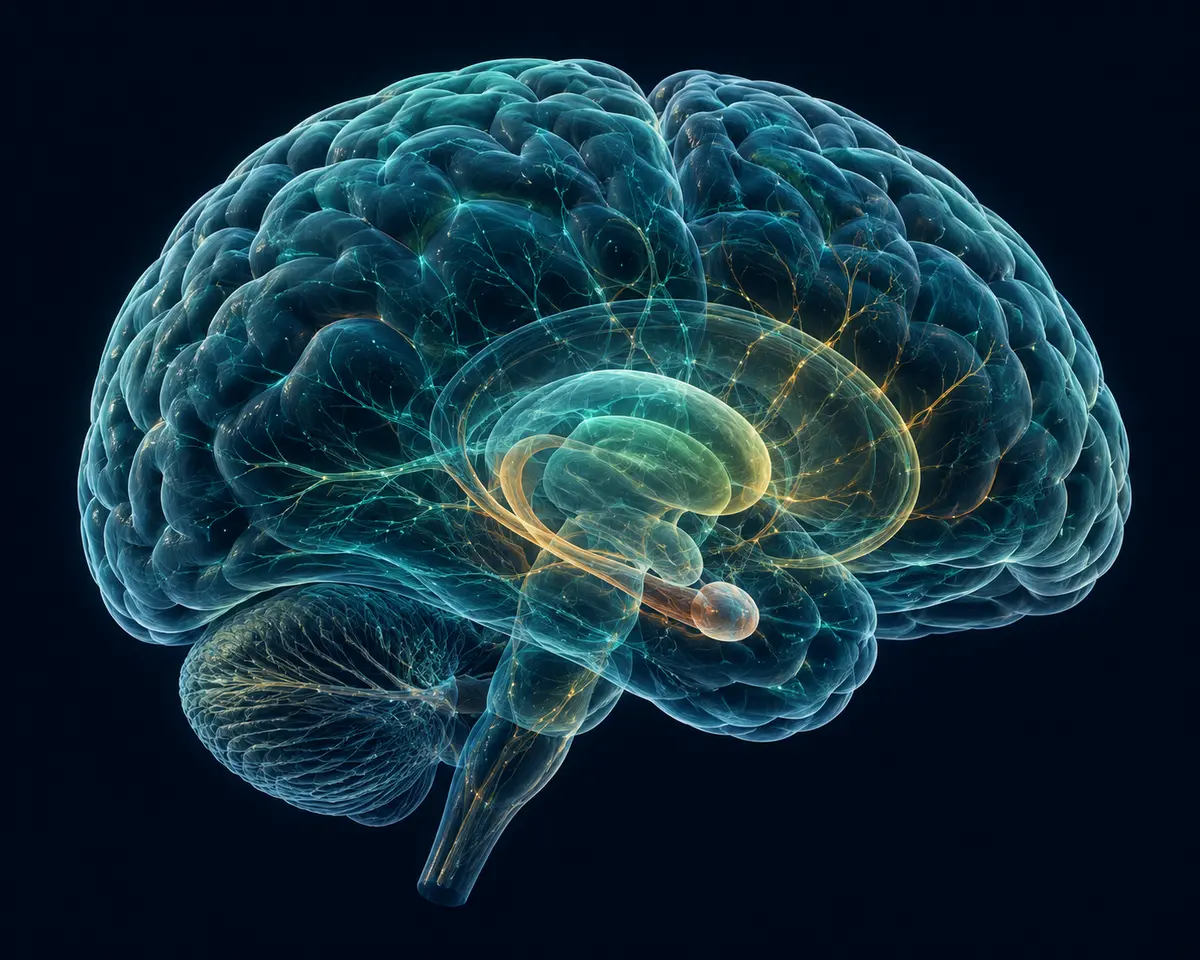
The Living Pathway Atlas keeps the systems layered: choose a chemical system, follow its routes, and notice how no psychiatric state belongs to one pathway. It is a conceptual anatomical map—not a personal scan, diagnosis or treatment recommendation.
Enter the Neuromodulatory Pathway Theatre