Input or initial state
The other person may change input, baseline, noise, starting state or observation while the underlying dynamics stay shared.
NEWEST CANONICAL LECTURE
Attachment, co-regulation and the geometry of the other—from human experience to evidence boundaries and formal specification.
Borrowed Gain Geometry (BGG) is a falsifiable Flow Hijacked synthesis and formal hypothesis. It is not an established clinical mechanism, validated therapeutic law, measured person-to-person operator or proof that one person can control another nervous system.
ONE OBSERVATION · COMPETING MODELS
The other person may change input, baseline, noise, starting state or observation while the underlying dynamics stay shared.
The same system may occupy a different operating point, so the same input receives a different gain.
BGG tests whether context changes an operator, coupling, delay or time-varying dynamics. Those models must outperform the simpler accounts.
Each layer adds depth without erasing the boundary conditions of the one before it.
EN / עברית
Both editions are complete, equal in depth and downloaded directly from the site.
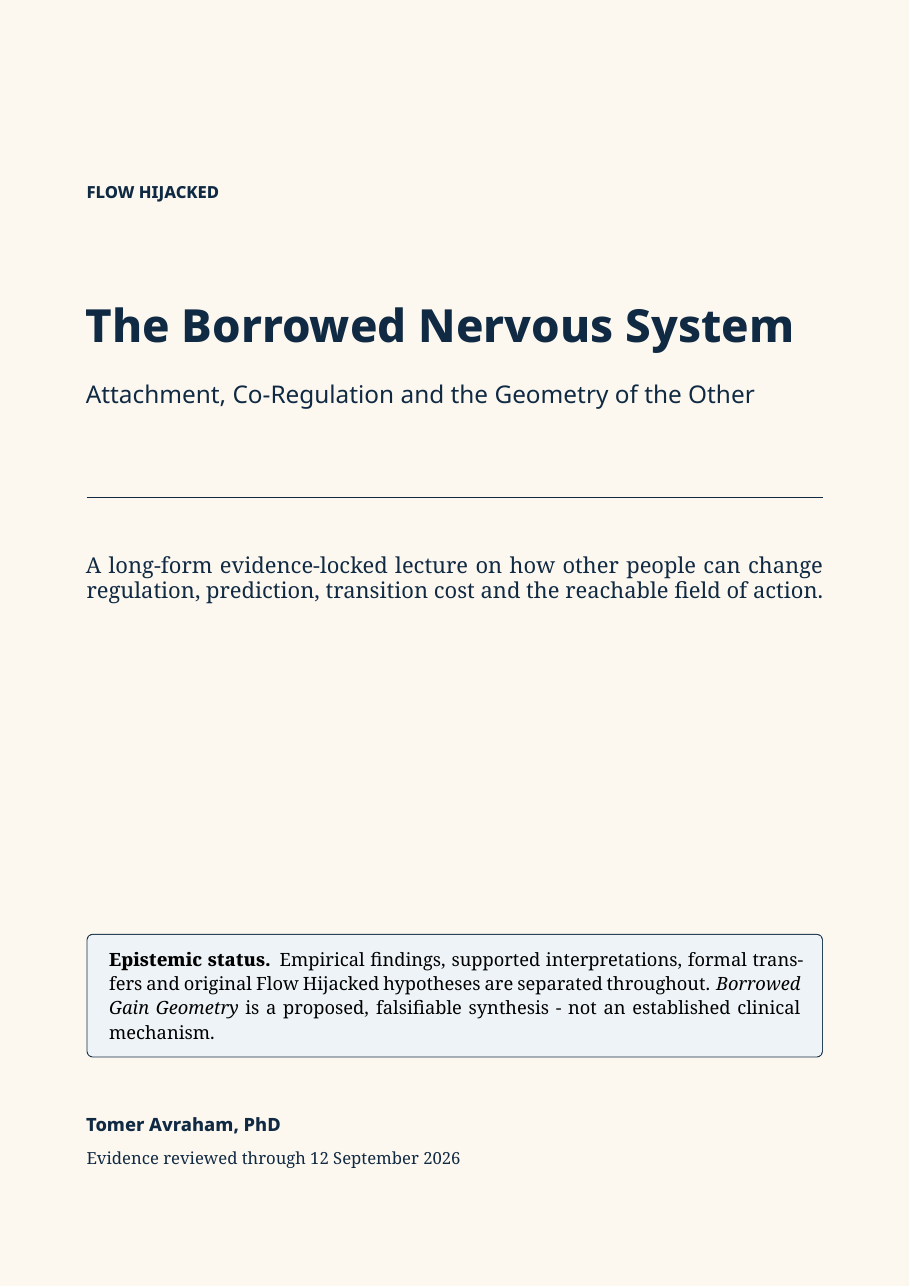
ENGLISH EDITION
Attachment, Co-Regulation and the Geometry of the Other
The latest expanded 74-page canonical English edition: 15 parts and 60 sections, with the empirical record, Flow Hijacked synthesis and formal Borrowed Gain Geometry specification kept visibly distinct.
The file is hosted directly by Flow Hijacked. If your device does not display PDFs well, use the download button.
CONTINUE INTO THE SYSTEM