ASKשאלו

LECTURE AND READING ROUTE · FLOW HIJACKED

Suicidal Crisis — When No Future Feels Reachable

Sometimes a person can know that tomorrow exists and still feel unable to find a way toward it. This lecture explores, with care, what happens to pain, time, relationships and the next step within a suicidal crisis, and what may help make another possibility reachable.

THE FILM

A place to listen to the question

The companion film to the lecture. Watch at a pace that works for you, and pause when you need to.

Open the film in Google Drive

RESEARCH ANCHORS

What the reading rests on

The lecture draws on a critical integrative review of 71 publications. It is not a preregistered systematic review. Supporting findings sit alongside conflicting results and questions that remain open.

Different paths into a crisis

Leading theories describe pain, a sense of being trapped and disrupted connection in different ways. Thoughts, intent and action are distinct; explaining one does not automatically explain the others.

Sources [1, 2, 3, 6]

What imagining tomorrow can tell us

Hopelessness and future thinking matter, but the findings are not uniform. Being able to picture a positive future does not necessarily make it feel attainable, and positive imagery is not always protective.

Sources [16, 18, 19, 21, 22]

A changing experience

Repeated observations show that suicidal thoughts can change over short periods. This improves our questions about timing; it does not yet give us a reliable personal forecast from a single pattern.

Sources [30, 33, 34, 40, 43]

Help, follow-up and continuity

Some interventions reduce suicidal behaviour in particular settings. Age, follow-up, the comparison treatment and the outcome measured all matter. A safety plan with continuing support is more than a worksheet.

Sources [44, 45, 48, 49, 51, 52]

Connection that can actually be reached

Support can exist while shame, fear, previous care experiences or practical barriers make it hard to use. Research that listens to people’s experiences adds detail that a symptom score cannot carry on its own.

Sources [59, 62, 63, 69, 70, 71]

The question this lecture proposes

Flow Hijacked asks what makes another future feel reachable through a step available now. This is an integrative research proposal, not a validated mechanism, diagnosis or tool for assessing someone’s safety.

Flow Hijacked synthesis and hypothesis
The 71-publication reference list
  1. Van Orden KA, Witte TK, Cukrowicz KC, Braithwaite SR, Selby EA, Joiner TE. (2010). The interpersonal theory of suicide. Psychological review.
  2. O'Connor RC, Kirtley OJ. (2018). The integrated motivational-volitional model of suicidal behaviour. Philosophical transactions of the Royal Society of London. Series B, Biological sciences.
  3. Klonsky ED; May AM (2015). The Three-Step Theory (3ST): A New Theory of Suicide Rooted in the “Ideation-to-Action” Framework. International Journal of Cognitive Therapy.
  4. Chu C, Buchman-Schmitt JM, Stanley IH, Hom MA, Tucker RP, Hagan CR, Rogers ML, Podlogar MC, Chiurliza B, Ringer FB, Michaels MS, Patros CHG, Joiner TE. (2017). The interpersonal theory of suicide: A systematic review and meta-analysis of a decade of cross-national research. Psychological bulletin.
  5. Dhingra K, Klonsky ED, Tapola V. (2019). An Empirical Test of the Three-Step Theory of Suicide in U.K. University Students. Suicide & life-threatening behavior.
  6. May AM; Klonsky ED (2016). What Distinguishes Suicide Attempters From Suicide Ideators? A Meta-Analysis of Potential Factors. Clinical Psychology: Science and Practice.
  7. Siddaway AP, Taylor PJ, Wood AM, Schulz J. (2015). A meta-analysis of perceptions of defeat and entrapment in depression, anxiety problems, posttraumatic stress disorder, and suicidality. Journal of affective disorders.
  8. Li S, Yaseen ZS, Kim HJ, Briggs J, Duffy M, Frechette-Hagan A, Cohen LJ, Galynker II. (2018). Entrapment as a mediator of suicide crises. BMC psychiatry.
  9. Ducasse D, Holden RR, Boyer L, Artéro S, Calati R, Guillaume S, Courtet P, Olié E. (2018). Psychological Pain in Suicidality: A Meta-Analysis. The Journal of clinical psychiatry.
  10. Yaseen ZS, Hawes M, Barzilay S, Galynker I. (2019). Predictive Validity of Proposed Diagnostic Criteria for the Suicide Crisis Syndrome: An Acute Presuicidal State. Suicide & life-threatening behavior.
  11. Forkmann T, Glaesmer H, Paashaus L, Rath D, Schönfelder A, Stengler K, Juckel G, Assion HJ, Teismann T. (2020). Interpersonal theory of suicide: prospective examination. BJPsych open.
  12. Souza K, Sosu EM, Thomson S, Rasmussen S. (2024). A systematic review of the studies testing the integrated motivational-volitional model of suicidal behaviour. Health psychology review.
  13. Kirshenbaum JS, Pagliaccio D, Bitran A, Xu E, Auerbach RP. (2024). Why do adolescents attempt suicide? Insights from leading ideation-to-action suicide theories: a systematic review. Translational psychiatry.
  14. Galynker I, Cohen L, Prekas AS, Bloch-Elkouby S, King M, Apter Levy Y. (2025). Suicide Crisis Syndrome: examining supporting evidence and barriers to diagnostic validity. Frontiers in psychiatry.
  15. Beck AT; Steer RA; Kovacs M; Garrison B (1985). Hopelessness and eventual suicide: a 10-year prospective study of patients hospitalized with suicidal ideation. American Journal of Psychiatry, 142(5), 559–563.
  16. Ribeiro JD; Huang X; Fox KR; Franklin JC (2018). Depression and hopelessness as risk factors for suicide ideation, attempts and death: meta-analysis of longitudinal studies. British Journal of Psychiatry, 212(5), 279–286.
  17. MacLeod AK; Pankhania B; Lee M; Mitchell D (1997). Parasuicide, depression and the anticipation of positive and negative future experiences. Psychological Medicine, 27(4), 973–977.
  18. O'Connor RC; Fraser L; Whyte MC; MacHale S; Masterton G (2008). A comparison of specific positive future expectancies and global hopelessness as predictors of suicidal ideation in a prospective study of repeat self-harmers. Journal of Affective Disorders, 110(3), 207–214.
  19. O'Connor RC; Smyth R; Williams JMG (2015). Intrapersonal positive future thinking predicts repeat suicide attempts in hospital-treated suicide attempters. Journal of Consulting and Clinical Psychology, 83(1), 169–176.
  20. Pollak OH; Guzmán EM; Shin KE; Cha CB (2021). Defeat, Entrapment, and Positive Future Thinking: Examining Key Theoretical Predictors of Suicidal Ideation Among Adolescents. Frontiers in Psychology, 12, 590388.
  21. Cha CB; Robinaugh DJ; Schacter DL; Altheimer G; Marx BP; Keane TM; Kearns JC; Nock MK (2022). Examining multiple features of episodic future thinking and episodic memory among suicidal adults. Suicide and Life-Threatening Behavior, 52(3), 356–372.
  22. Cha CB; Nam RJ; Bell KA; Goger P; Parvez N; Pollak OH; Robinaugh DJ; Sanghvi D; Schacter DL (2024). An Examination of Episodic Future Thinking and Episodic Memory Among Suicidal and Nonsuicidal Adolescents. Journal of Clinical Child & Adolescent Psychology, 53(6), 908–921.
  23. Köse G; Evans JJ; O'Connor RC (2025). The relationship between positive future thinking, entrapment, defeat and death-related mental imagery in individuals with and without a suicidal history: an experimental study. Frontiers in Psychology, 16, 1574315.
  24. Richard-Devantoy S; Berlim MT; Jollant F (2015). Suicidal behaviour and memory: A systematic review and meta-analysis. World Journal of Biological Psychiatry, 16(8), 544–566.
  25. Pollock LR; Williams JMG (2001). Effective Problem Solving in Suicide Attempters Depends on Specific Autobiographical Recall. Suicide and Life-Threatening Behavior, 31(4), 386–396.
  26. Cheek SM; Kudinova AY; Kuzyk EG; Goldston DB; Liu RT (2023). Cognitive inflexibility and suicidal ideation among adolescents following hospitalization: The moderating role of life stress. Journal of Affective Disorders, 339, 698–705.
  27. Tsypes A; Szanto K; Bridge JA; Brown VM; Keilp JG; Dombrovski AY (2022). Delay discounting in suicidal behavior: Myopic preference or inconsistent valuation?. Journal of Psychopathology and Clinical Science, 131(1), 34–44.
  28. Tsypes A; Hallquist MN; Ianni A; Kaurin A; Wright AGC; Dombrovski AY (2024). Exploration-Exploitation and Suicidal Behavior in Borderline Personality Disorder and Depression. JAMA Psychiatry, 81(10), 1010–1019.
  29. Nam RJ; Cha CB (2026). How Teens Imagine Tomorrow: Hopelessness and Suicidality Across Latent Classes of Episodic Future Thinking. Research on Child and Adolescent Psychopathology, 54, article 73.
  30. Franklin JC, Ribeiro JD, Fox KR, Bentley KH, Kleiman EM, Huang X, Musacchio KM, Jaroszewski AC, Chang BP, Nock MK (2017). Risk factors for suicidal thoughts and behaviors: A meta-analysis of 50 years of research. Psychological Bulletin, 143(2), 187-232.
  31. Carter G, Milner A, McGill K, Pirkis J, Kapur N, Spittal MJ (2017). Predicting suicidal behaviours using clinical instruments: systematic review and meta-analysis of positive predictive values for risk scales. The British Journal of Psychiatry, 210(6), 387-395.
  32. Belsher BE, Smolenski DJ, Pruitt LD, Bush NE, Beech EH, Workman DE, Morgan RL, Evatt DP, Tucker J, Skopp NA (2019). Prediction Models for Suicide Attempts and Deaths: A Systematic Review and Simulation. JAMA Psychiatry, 76(6), 642-651.
  33. Seyedsalehi A, Bailey J, Ogonah MGT, Fanshawe TR, Fazel S (2025). Prediction models for self-harm and suicide: a systematic review and critical appraisal. BMC Medicine, 23(1), 549.
  34. Kleiman EM, Turner BJ, Fedor S, Beale EE, Huffman JC, Nock MK (2017). Examination of real-time fluctuations in suicidal ideation and its risk factors: Results from two ecological momentary assessment studies. Journal of Abnormal Psychology, 126(6), 726-738.
  35. Kivelä L, van der Does WAJ, Riese H, Antypa N (2022). Don't Miss the Moment: A Systematic Review of Ecological Momentary Assessment in Suicide Research. Frontiers in Digital Health, 4, 876595.
  36. Kaurin A, Dombrovski AY, Hallquist MN, Wright AGC (2022). Integrating a functional view on suicide risk into idiographic statistical models. Behaviour Research and Therapy, 150, 104012.
  37. Czyz EK, King CA, Al-Dajani N, Zimmermann L, Hong V, Nahum-Shani I (2023). Ecological Momentary Assessments and Passive Sensing in the Prediction of Short-Term Suicidal Ideation in Young Adults. JAMA Network Open, 6(8), e2328005.
  38. Kivelä LMM, Fried EI, van der Does W, Antypa N (2024). Examining contemporaneous and temporal associations of real-time suicidal ideation using network analysis. Psychological Medicine, 54(12), 3357-3365.
  39. Bryan CJ, Daruwala SE, Bozzay ML (2025). Temporal dynamics of the wish to live and wish to die signal near-term increases in suicidal thinking in a veteran sample. Journal of Psychiatric Research, 189, 471-478.
  40. Bryan CJ, Bozzay ML, Hay J, Starkey A, Tabares JV, Baker JC (2025). Changing temporal patterns in patient-reported wish to live and wish to die signal the imminent emergence and aftermath of suicide attempts: a dynamical systems analysis. BMC Psychiatry, 25(1), 884.
  41. Nobile B, Gourguechon-Buot E, Olié E, Courtet P (2025). Risk factors of transition from suicidal ideation to suicide attempt: A one-year longitudinal study among hospital-based in- and outpatients. Journal of Affective Disorders, 390, 119854.
  42. Batterham PJ, O'Dea B, Borschmann R, Calear AL, Farrer LM, Han J, Gendi M, Heffernan C, Christensen H (2026). The association of short-term variability in suicidal ideation with subsequent suicidal thoughts and behaviours: Longitudinal cohort study. Behaviour Research and Therapy, 202, 105049.
  43. Cha CB, Shin KEK, Parvez N, Nam R, Bassing M (2026). Experience Sampling of Future Thinking and Suicidal Ideation Among Adolescents. Archives of Suicide Research, advance online publication, 1–19.
  44. Stanley B; Brown GK; Brenner LA; Galfalvy HC; Currier GW; Knox KL; Chaudhury SR; Bush AL; Green KL (2018). Comparison of the Safety Planning Intervention With Follow-up vs Usual Care of Suicidal Patients Treated in the Emergency Department. JAMA Psychiatry.
  45. Albaum C; Irwin SH; Muha J; Schumacher A; Clarissa S; Finkelstein Y; Bridge JA; Korczak DJ (2025). Safety Planning Interventions for Suicide Prevention in Children and Adolescents: A Systematic Review and Meta-Analysis. JAMA Pediatrics.
  46. Homan S; Marciniak MA; Michel S; Bertram AM; Rühlmann C; Pethő A; Kirchhofer L; Biele L; Segerer R; Homan P; Olbrich S; O’Connor RC; Kleim B (2026). Effectiveness of brief interventions and contacts after suicide attempt: a systematic review and meta-analysis. eClinicalMedicine.
  47. Boudreaux ED; Larkin C; Sefair AV; Ma Y; Li YF; Ibrahim AF; Zeger W; Brown GK; Pelletier L; Miller I; ED-SAFE 2 Investigators (2023). Effect of an Emergency Department Process Improvement Package on Suicide Prevention: The ED-SAFE 2 Cluster Randomized Clinical Trial. JAMA Psychiatry.
  48. Baker JC; Starkey A; Ammendola E; Bauder CR; Daruwala SE; Hiser J; Khazem LR; Rademacher K; Hay J; Bryan AO; Bryan CJ (2024). Telehealth Brief Cognitive Behavioral Therapy for Suicide Prevention: A Randomized Clinical Trial. JAMA Network Open.
  49. McCauley E; Berk MS; Asarnow JR; Adrian M; Cohen J; Korslund K; Avina C; Hughes J; Harned M; Gallop R; Linehan MM (2018). Efficacy of Dialectical Behavior Therapy for Adolescents at High Risk for Suicide: A Randomized Clinical Trial. JAMA Psychiatry.
  50. Swift JK; Trusty WT; Penix EA (2021). The effectiveness of the Collaborative Assessment and Management of Suicidality (CAMS) compared to alternative treatment conditions: A meta-analysis. Suicide and Life-Threatening Behavior.
  51. Gysin-Maillart A; Schwab S; Soravia L; Megert M; Michel K (2016). A Novel Brief Therapy for Patients Who Attempt Suicide: A 24-months Follow-Up Randomized Controlled Study of the Attempted Suicide Short Intervention Program (ASSIP). PLOS Medicine.
  52. Monn A; Villar de Araujo T; Rüesch A; Kronenberg G; Hörmann C; Adank A; Roman Z; Schoretsanitis G; Rufer M; Seifritz E; Kleim B; Olbrich S (2025). Randomized controlled trial for the Attempted Suicide Short Intervention Program (ASSIP): An independent non-replication study. Journal of Affective Disorders.
  53. Steeg S; Ledden S; Marzano L; Dutta R; Quinlivan L; Kapur N; John A; Webb RT (2025). Effectiveness of suicide means restriction: an overview of systematic reviews. BMJ Mental Health.
  54. Wang JX; Le GH; Wong S; Teopiz KM; Kwan ATH; Rosenblat JD; Rhee TG; Ho R; Lo HKY; Goldberg JF; Vinberg M; Grande I; Mansur R; Meyer JM; McIntyre RS (2025). The efficacy of lithium in the treatment of suicidal ideation, behavior and suicide: An updated systematic review and meta-analysis of randomized controlled trials. Journal of Affective Disorders.
  55. Abbar M; Demattei C; El-Hage W; Llorca PM; Samalin L; Demaricourt P; Gaillard R; Courtet P; Vaiva G; Gorwood P; Fabbro P; Jollant F (2022). Ketamine for the acute treatment of severe suicidal ideation: double blind, randomised placebo controlled trial. BMJ.
  56. Bryan CJ; Mintz J; Clemans TA; Leeson B; Burch TS; Williams SR; Maney E; Rudd MD (2017). Effect of crisis response planning vs. contracts for safety on suicide risk in U.S. Army Soldiers: A randomized clinical trial. Journal of Affective Disorders.
  57. Janssen WC; Mérelle SYM; van Ballegooijen W; Gilissen R; Bockting CLH (2025). Cognitive Behavior Therapy With and Without Narrative Assessment and Suicide Attempts: A Systematic Review and Meta-Analysis. JAMA Network Open.
  58. Maxwell CA; Holland KE; Young L; Chen EY; Olino T; Kendall PC (2026). The Effectiveness of Dialectical Behavior Therapy in Reducing Self-Directed Violence and Suicidality in Usual Care Settings: A Meta-Analysis. Journal of Clinical Psychology.
  59. McClelland H; Evans JJ; Nowland R; Ferguson E; O'Connor RC (2020). Loneliness as a predictor of suicidal ideation and behaviour: a systematic review and meta-analysis of prospective studies. Journal of Affective Disorders, 274, 880–896.
  60. Batterham PJ; Walker J; Leach LS; Ma J; Calear AL; Christensen H (2018). A longitudinal test of the predictions of the interpersonal-psychological theory of suicidal behaviour for passive and active suicidal ideation in a large community-based cohort. Journal of Affective Disorders, 227, 97–102.
  61. Otten D; Ernst M; Tibubos AN; Brähler E; Fleischer T; Schomerus G; Wild PS; Zöller D; Binder H; Kruse J; Johar H; Atasoy S; Grabe HJ; Ladwig KH; Münzel T; Völzke H; König J; Beutel ME (2022). Does social support prevent suicidal ideation in women and men? Gender-sensitive analyses of an important protective factor within prospective community cohorts. Journal of Affective Disorders, 306, 157–166.
  62. Hallford DJ; Rusanov D; Winestone B; Kaplan R; Fuller-Tyszkiewicz M; Melvin G (2023). Disclosure of suicidal ideation and behaviours: A systematic review and meta-analysis of prevalence. Clinical Psychology Review, 101, 102272.
  63. Han J; Batterham PJ; Calear AL; Randall R (2018). Factors Influencing Professional Help-Seeking for Suicidality. Crisis, 39(3), 175–196.
  64. Borges G; Bagge CL; Cherpitel CJ; Conner KR; Orozco R; Rossow I (2017). A meta-analysis of acute use of alcohol and the risk of suicide attempt. Psychological Medicine, 47(5), 949–957.
  65. Liu RT; Steele SJ; Hamilton JL; Do QBP; Furbish K; Burke TA; Martinez AP; Gerlus N (2020). Sleep and suicide: A systematic review and meta-analysis of longitudinal studies. Clinical Psychology Review, 81, 101895.
  66. Howarth EJ; O'Connor DB; Panagioti M; Hodkinson A; Wilding S; Johnson J (2020). Are stressful life events prospectively associated with increased suicidal ideation and behaviour? A systematic review and meta-analysis. Journal of Affective Disorders, 266, 731–742.
  67. Angelakis I; Gillespie EL; Panagioti M (2019). Childhood maltreatment and adult suicidality: a comprehensive systematic review with meta-analysis. Psychological Medicine, 49(7), 1057–1078.
  68. Nock MK; Hwang I; Sampson N; Kessler RC; Angermeyer M; Beautrais A; Borges G; Bromet E; Bruffaerts R; de Girolamo G; de Graaf R; Florescu S; Gureje O; Haro JM; Hu C; Huang Y; Karam EG; Kawakami N; Kovess V; Levinson D; Posada-Villa J; Sagar R; Tomov T; Viana MC; Williams DR (2009). Cross-national analysis of the associations among mental disorders and suicidal behavior: findings from the WHO World Mental Health Surveys. PLoS Medicine, 6(8), e1000123.
  69. Lakeman R; FitzGerald M (2008). How people live with or get over being suicidal: a review of qualitative studies. Journal of Advanced Nursing, 64(2), 114–126.
  70. Hechinger M; Fringer A (2021). Professional Care Experiences of Persons With Suicidal Ideation and Behavior: Model Development Based on a Qualitative Meta-Synthesis. JMIR Formative Research, 5(10), e27676.
  71. Fusar-Poli P; Esposito CM; Estradé A; Rosfort R; Mancini M; Jackman M; Sugianto A; Berk E; Prawira B; Wangui LN; Agaba A; Cullen J; O'Connor RR; Marsh I; Shamsaei F; Bonoldi I; Stefana A; Damiani S; Basadonne I; Singh A; Fontana S; Curti I; Massari L; Legittimo A; Cortese S; Yon DK; Shin JI; Madeira L; Stanghellini G; Rossi Monti M; Ratcliffe M; Pompili M; Maj M (2026). The lived experience of persons who attempt suicide: a bottom-up review co-designed, co-produced and co-written by experts by experience and academics. World Psychiatry, 25(1), 34–49.

Additional mathematical background, separate from the 71 publications on suicidality:

[M1] Trefethen, L. N., & Embree, M. (2005). Spectra and Pseudospectra: The Behavior of Nonnormal Matrices and Operators. Princeton University Press. Author’s book list

Part 1

Entering the Crisis Without Reducing the Person to It

01

Chapter 1

When Tomorrow Exists but No Longer Feels Reachable

Someone may know that an appointment, a conversation or another week lies ahead, yet feel unable to move toward any of them. The distance can be hard to see from outside. We begin by listening to that gap, without assuming that everyone experiences crisis in the same way. The question is what makes another possibility feel out of reach, and what might help make a safe next step available.

02

Chapter 2

Thoughts, Distress, Intent, and Action

A painful thought, a wish for relief, an intention and an action are different things. Taking someone's distress seriously means making room for those differences. A single answer cannot tell us everything about a person or what will happen next. This chapter offers words that help us listen more carefully, without turning a conversation into a label or expecting the person to explain everything perfectly. [6, 13]

03

Chapter 3

Different Maps of the Same Pain

Researchers have offered different explanations for suicidal distress. Some focus on pain and hopelessness, others on feeling trapped, disconnected or like a burden. Each brings something into view, and each leaves questions open. We will use these explanations as maps that can guide attention. A map can help us ask where someone is struggling; it cannot replace meeting the person or knowing the circumstances of their life. [1, 2, 3]

Part 2

What It Takes to Have a Future

04

Chapter 4

Remembering in Order to Imagine

A particular memory can contain something a general reassurance cannot: who was there, what changed, and how the next step happened. Research asks how remembering and imagining are connected, including when someone is struggling. The findings are mixed, and memory exercises are not an established answer to suicidal crisis. The useful question here is gentler: what concrete experiences can this person draw on, and where does drawing on them become difficult? [21, 22, 24, 25]

05

Chapter 5

A Future We Can Imagine and a Future We Can Reach

Being able to picture a better day does not necessarily make that day feel reachable. Getting there may involve transport, money, an unfamiliar conversation or help that has not yet become available. We separate the picture from the path. Future accessibility is the name Flow Hijacked gives this question: what connects an imaginable possibility to a step someone can actually begin? It is a proposal for understanding, not a way to score a person's safety.

06

Chapter 6

When Even a Better Tomorrow Becomes a Burden

A hopeful image can comfort someone, but it can also make the distance from the present feel sharper. The research does not support asking everyone simply to imagine something positive. This does not mean hope is harmful. It means we need to understand what an imagined future means to this person. There can be room for hope without demanding optimism, and room for painful uncertainty without deciding that nothing can change. [19, 20, 43]

Part 3

How the Paths Begin to Narrow

07

Chapter 7

When There Seems to Be No Way Out

Feeling trapped means needing a way out and being unable to find one. It deserves careful attention, but it does not tell us that a person will inevitably act on suicidal thoughts. Sometimes the obstacle is fear; sometimes it is a circumstance that really limits the available options. We look at both. Listening carefully includes asking what makes a suggested way forward unusable, instead of assuming that naming an option makes it accessible. [7, 12]

08

Chapter 8

When Every Step Costs Too Much

A step that looks small from outside may contain several difficult tasks. Making an appointment can mean finding words for distress, arranging transport and facing uncertainty about the response. We slow down enough to notice those hidden demands. This is an illustration, not an explanation of every crisis. It changes the question from whether a step seems easy to what it would actually require, and what support could make beginning more manageable.

09

Chapter 9

When Connection Exists but Help Remains Out of Reach

Having people who care is not always the same as being able to reach them. Someone may fear causing worry, lack privacy or be unsure how their words will be received. Research on seeking help reminds us that these barriers vary. We explore the distance between a relationship that exists and support that can actually be used, while remembering that loved ones also need support and cannot carry responsibility alone. [62, 63, 70]

Part 4

Time Within the Crisis

10

Chapter 10

When the Present Fills the Horizon

There is a difference between knowing that time will pass and being able to feel beyond the present. Someone may imagine next year in detail while finding the next hour unbearable. We distinguish these experiences instead of calling all of them a lost future. The aim is to hear what time feels like for this person, without turning one description into a rule about everyone who experiences suicidal distress. [21, 27, 43]

11

Chapter 11

From Hour to Hour

How someone feels in the morning may not tell the whole story of the evening. Studies that ask people about their experiences repeatedly show changes, sometimes over short periods. The pattern differs between people, and a change by itself cannot tell us what will happen next. This chapter makes room for a person whose answer changes, rather than treating the earlier answer as the only true one. [34, 35, 42]

12

Chapter 12

What We Can Predict and What We Cannot Yet Conclude

It is understandable to want a number that will tell us what happens next. Research can improve what we know, but prediction still has important limits, especially for an individual person. A questionnaire cannot hold the whole conversation. We explore what evidence can help with, where certainty would be misleading, and why uncertainty is a reason for attentive care rather than a reason to stop listening. [30, 31, 33]

Part 5

The Conditions Surrounding the Person

13

Chapter 13

Beyond a Single Diagnosis

A diagnosis may explain part of someone's experience, but it does not contain the whole person. Sleep, alcohol, painful memories, current illness and the demands of daily life can raise different questions. Their importance depends on the person and the moment. We look beyond a single label without dismissing medical care, and avoid treating a past difficulty as a fixed prediction of someone's future. [64, 65, 67, 68]

14

Chapter 14

When the World Really Does Close Off Possibilities

Sometimes a suggested option is unavailable for a very concrete reason. A person may lack money for transport, a safe place to stay or an appointment they can attend. These examples remind us to examine real circumstances alongside feelings and thoughts. Compassion includes taking practical barriers seriously. Asking someone to see more possibilities is incomplete if no one asks whether those possibilities are actually open to them.

15

Chapter 15

When Continuity Breaks

A change in care, a move or the end of a familiar routine can leave questions that are easy to overlook: who knows what has happened, who is expecting the next call, and where does the person turn now? These are illustrations of continuity, not a formula for predicting crisis. We consider how a handover can make the next contact clearer, while allowing people to need different kinds of support at different times.

Part 6

Expanding What Is Possible Again

16

Chapter 16

What Actually Helps

There are reasons to take treatment seriously, alongside reasons to be precise about what it can promise. Helping with thoughts, reducing attempts and preventing deaths are different outcomes. An approach may help one group without having the same evidence for another. We look at encouraging findings and results that were not repeated, so that hope rests on an honest account of care rather than on the most impressive headline. [44, 45, 49, 51, 52]

17

Chapter 17

Turning Help into a Step Someone Can Take

Being given a list of contacts does not answer every question about reaching help. Can the person make the call? Is someone available? What happens after the first conversation? Research on safety planning and continuing contact asks us to consider the surrounding care, not just the document. We explore how support can become more usable, with responsibility shared appropriately between the person, people close to them and professional services. [44, 47, 56]

18

Chapter 18

Working with Pain, Flexibility, and Problem Solving

Pain can need attention long before a person can imagine a different life. Some treatments work directly with suicidal distress; others help develop ways of responding to difficult emotions and situations. Their evidence varies, and no single skill explains every improvement. We look at what it means to understand someone's own path into difficulty, and to practice responses that fit their circumstances rather than offering the same answer to everyone. [48, 49, 50, 57, 58]

19

Chapter 19

A Future We Can Begin Moving Toward

Recovery does not have to begin with a convincing picture of a wonderful future. Accounts from people with lived experience describe different ways of living with difficulty, reconnecting and finding something that matters. These accounts offer understanding, not a guaranteed sequence. We make room for gradual change, for help that remains necessary, and for a life that can become more livable without requiring someone to declare that everything is now resolved. [69, 70, 71]

Part 7

The Flow Hijacked Synthesis and How to Test It

20

Chapter 20

Future Accessibility Through the Flow Hijacked Lens

Several difficulties can reinforce one another: distress can make asking harder, an unanswered need can deepen distress, and a practical barrier can close off a promising step. Flow Hijacked proposes looking at these interactions together. This is a framework to investigate, not a proven explanation of every crisis. Its value would be in helping us see where a change in the person’s surroundings or support could make a meaningful difference.

21

Chapter 21

How Would We Know Whether the Framework Holds?

An explanation can feel compassionate and still be incomplete or mistaken. We therefore ask what could show that this framework adds something useful, and what would show that it does not. Does it explain more than familiar ideas about pain, hopelessness and feeling trapped? Does it fit people with different experiences? A responsible proposal must leave room for correction, including the possibility that a simpler explanation works better.

22

Chapter 22

Restoring Possibility Without Promising Certainty

We end without asking anyone to promise that they can already see a better future. Understanding may begin with a more modest question: what would make the next safe step more possible? Research, thoughtful care and attention to actual circumstances can inform that question, even when they cannot offer certainty. A person’s need for support does not depend on accepting a theory, finding the right words or feeling hopeful on demand.

CONTINUE INTO THE COMPLETE LECTURE

The longer conversation begins here.

The complete lecture develops each chapter, connects evidence with experience and leaves room for what research does not yet know. Both editions include the full reference list.

Read the complete lecture

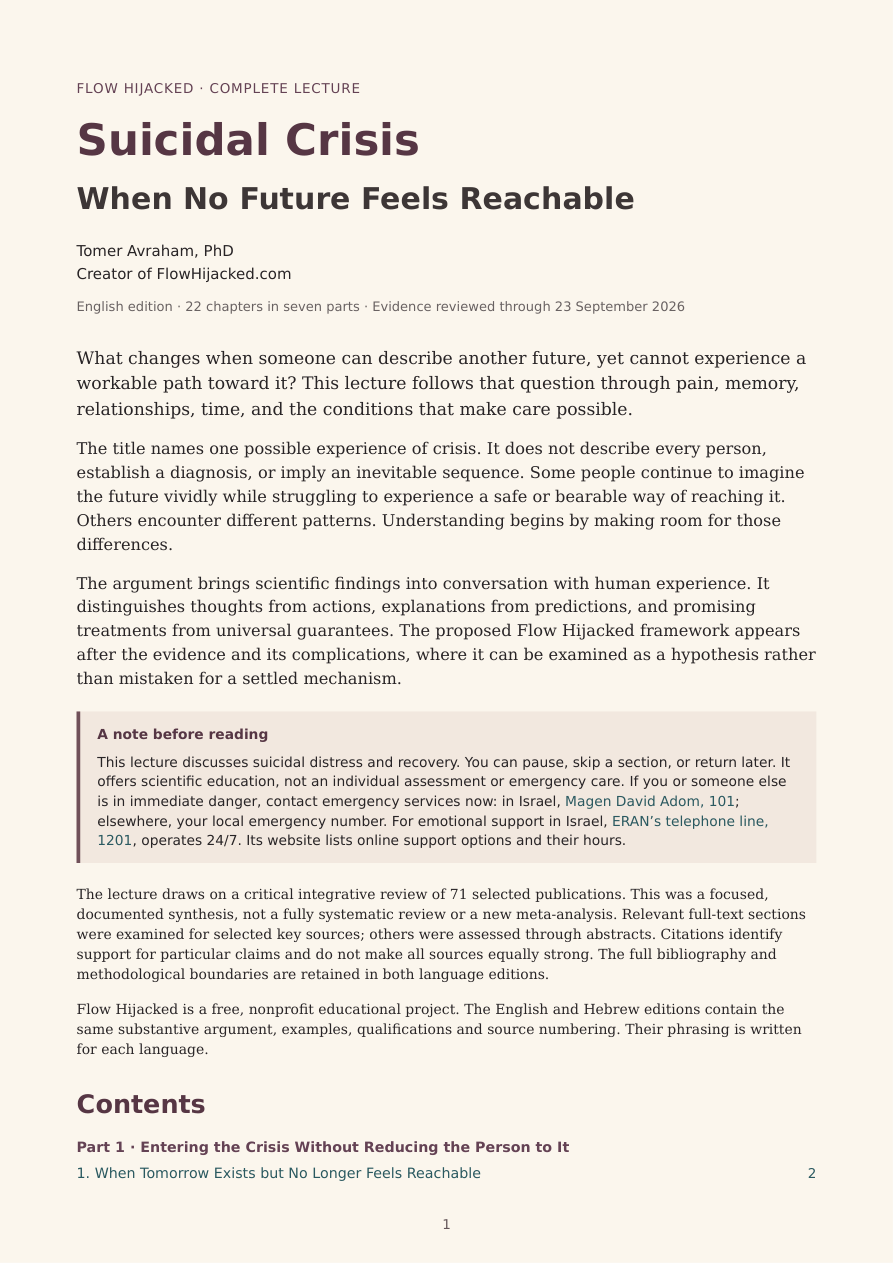
THE COMPLETE LECTURE · ENGLISH AND HEBREW

Read, save and return when it suits you.

The same seven parts and 22 chapters, written in full in both languages. The English edition is displayed below; either edition can also be opened separately or downloaded.
READ ON THIS PAGE

The complete English lecture

Open in a separate window

CONTINUE FROM HERE

More ways to understand and find support.