USE THIS FIRST
A scan-ready answer for the moment you are in
I cannot look forward to it
Something may still feel good once it begins even when the future reward has lost its pull.
I cannot make myself begin
The bottleneck may be energy, sleep, effort or entry cost rather than the capacity for pleasure itself.
It does not feel good when I do it
Sensory, social and emotional pleasure can separate; persistence and overlap deserve assessment.
EVIDENCE POSITION
Moderate evidence that anhedonia and negative affect can matter in abstinence; low confidence in predicting an individual's duration or mechanism.
The purpose is not remote diagnosis. It is to separate what can be said confidently, what still varies from person to person, and which next action may be safe and useful now.
FIELD MAP
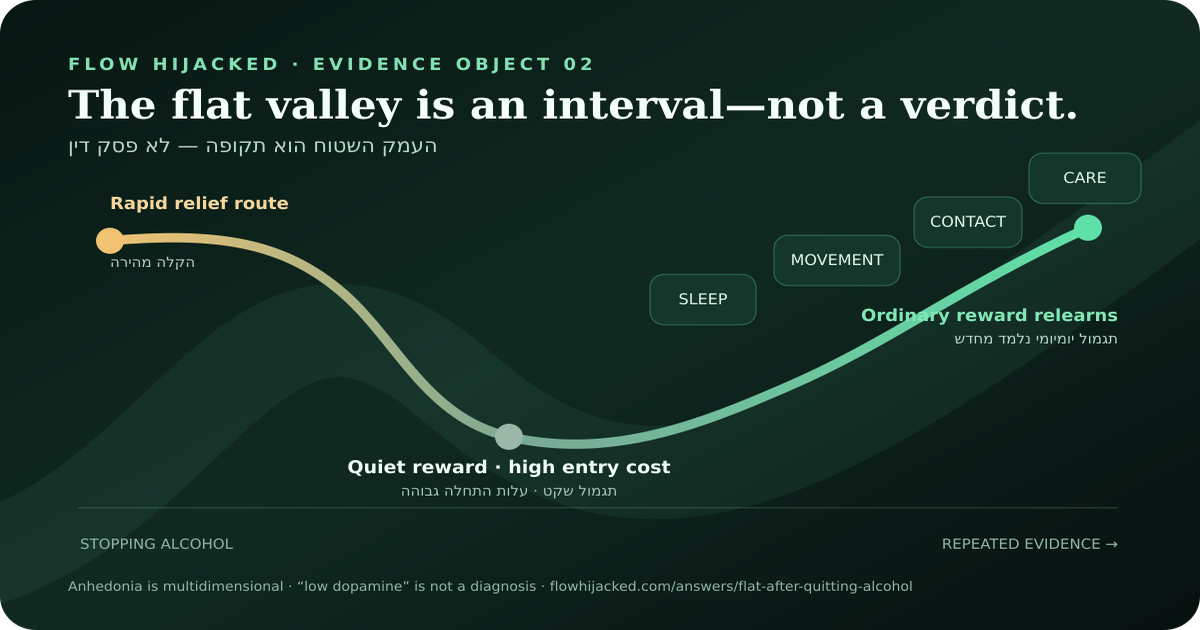
Relief disappears faster than ordinary reward relearns
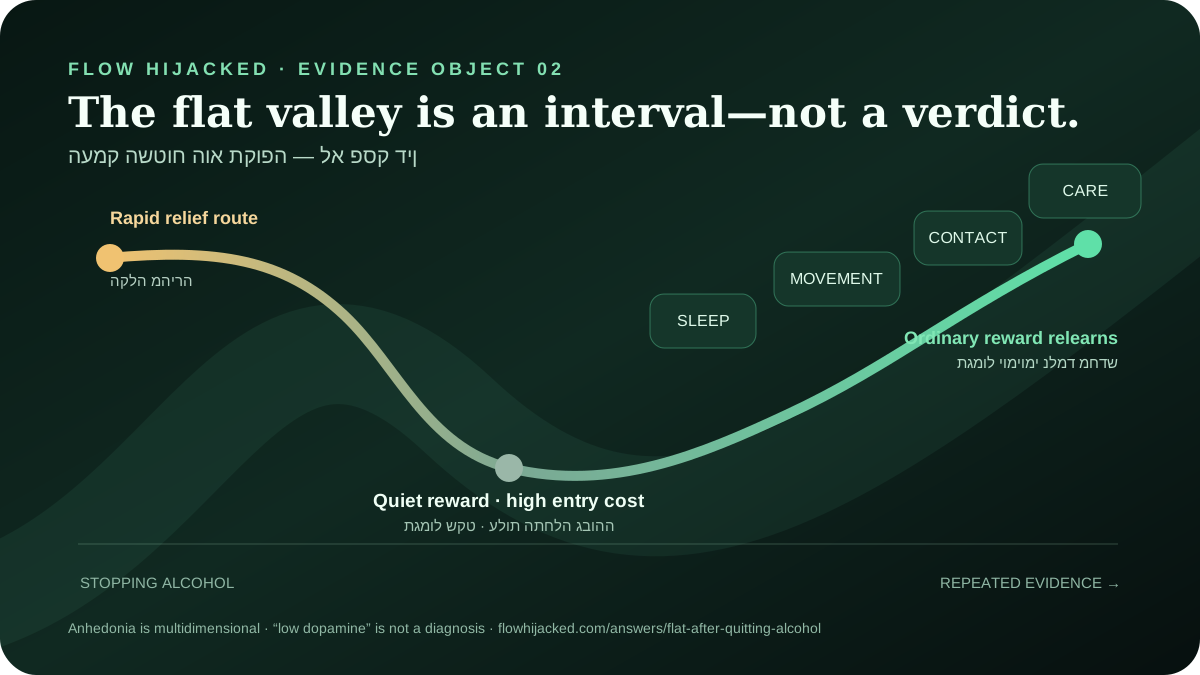
A trajectory drops when rapid alcohol relief is removed, crosses a flat valley of quiet ordinary reward and gradually rises through repeated sleep, movement, contact and treatment inputs.
- 01
Fast regulator removed
Alcohol no longer supplies rapid distance from stress, memory, loneliness or sleeplessness.
- 02
Stress remains loud
Withdrawal, poor sleep and ordinary problems may still amplify negative affect.
- 03
Ordinary reward is quiet
Small rewards may not yet recruit anticipation, effort and learning strongly.
- 04
Relearning needs repetition
Reliable sleep, movement, contact and action can create evidence before motivation feels convincing.
Anhedonia is not one thing
A person may still enjoy something once it begins but feel no anticipation; may want an outcome but lack the energy to start; or may complete an activity without the experience updating future motivation. Social pleasure and sensory pleasure can also separate.
This distinction matters because 'do more pleasant activities' can fail when initiation cost is the bottleneck. The first useful target may be sleep, withdrawal care, company, transport, medication review or an action small enough to begin without waiting for desire.
Why the dopamine story is too small
Dopamine participates in learning, incentive salience, effort and movement, but it is not a global pleasure meter. Alcohol recovery also involves stress systems, glutamate and GABA adaptation, sleep, metabolism, memory, social context and the meaning attached to ordinary life.
A mechanistic explanation should reduce shame and improve the next assessment. It should not become a home laboratory or a reason to chase stimulation.
NOT EVERYTHING AT ONCE
Three proportionate actions
- 01
Describe the pattern
Track anticipation, initiation, enjoyment, sleep, energy and social contact separately for a week; bring the pattern to care rather than only saying 'I feel flat.'
- 02
Lower the entry cost
Choose one action small enough to begin before motivation arrives, preferably with light, movement, nourishment or another person.
- 03
Review persistence and overlap
Ask a clinician to review depression, bipolarity, sleep, medication, pain and medical contributors when flatness is severe, persistent or worsening.
GO DEEPER
The canonical knowledge behind this answer
Anhedonia, reward relearning and differential assessment.
Dopamine without mythologyPathways, timescales and the rest of the neuromodulatory orchestra.
Depression hubWhole-system assessment and treatment routes.
Inspect wanting, liking & dopamineClaim-level sources and limits behind the chemistry explanation.
COMMON QUESTIONS
The short answers people are looking for
How long can emotional flatness last after quitting alcohol?
There is no validated personal timetable. Sleep, stress, mood, reward learning, medication and health can change on different clocks. Severe, persistent or worsening flatness deserves clinical review.
Is this low dopamine or depression?
Neither can be diagnosed from the feeling alone. Dopamine is not a global pleasure meter, and depression, bipolar-spectrum states, trauma, sleep, medication and medical illness can overlap.
What may help before motivation returns?
Lower the entry cost: one small, repeatable action involving light, movement, nourishment, contact or treatment can create experience before desire feels convincing.
INFERENCE BOUNDARY
What this page still cannot know
- There is no validated personal timetable for reward recovery after alcohol.
- Feeling flat can be part of abstinence, an independent condition, a treatment effect or several coupled processes.
Primary evidence anchors
The Cycle of Alcohol Addiction ↗
NIAAA · reviewed 2025
The interaction of reward, stress and executive-control systems across intoxication, withdrawal and anticipation.Acute withdrawal, protracted abstinence and negative affect in alcoholism ↗
Molecular Psychiatry / PMC · 2010
Negative affect and anhedonia can extend beyond the brief acute-withdrawal window, while mechanisms and trajectories vary.Anhedonia and Substance Dependence: Clinical Correlates and Treatment Options ↗
Frontiers in Psychiatry / PMC · 2011
Anhedonia is multidimensional and can matter during abstinence without being reducible to one neurotransmitter reading.Alcohol Use Disorder and Common Co-Occurring Conditions ↗
NIAAA Core Resource · 2025
Sleep disturbance, dysphoria and other symptoms can overlap across alcohol cycles and independent mental-health conditions.