Original paper
What’s next for interoception and addiction?
Davin R. Peart & Jennifer E. Murray. Neuroscience & Biobehavioral Reviews, 189 (2026), 106875.
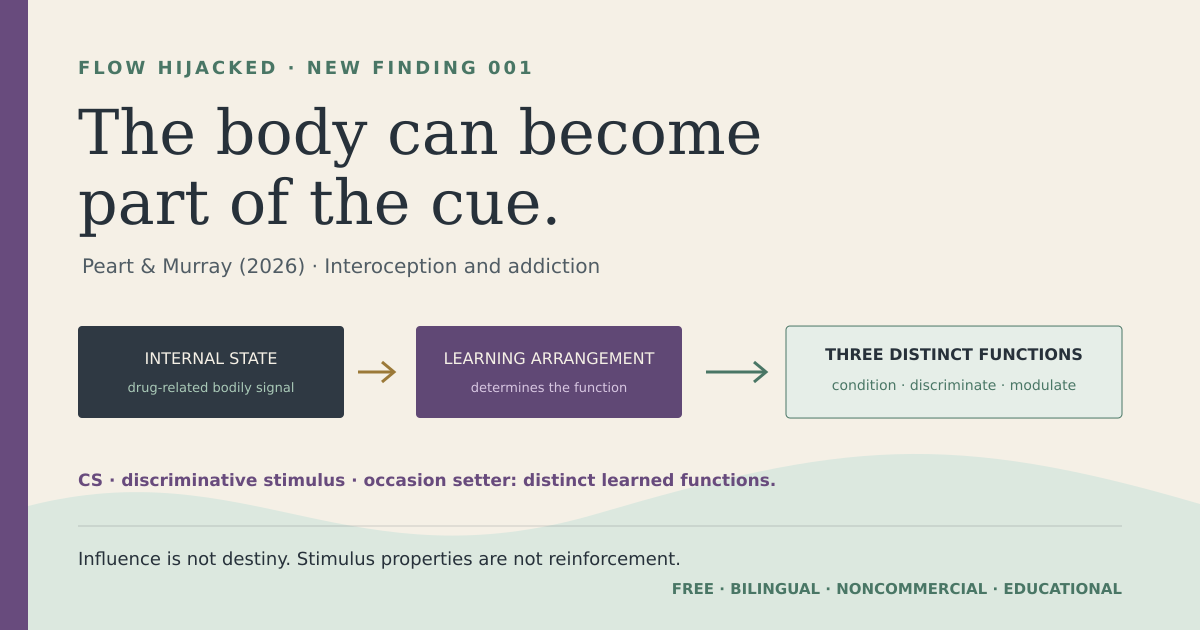
The review’s organizing move is to foreground a drug-produced internal state as a learned stimulus with behavioral functions of its own, while keeping those stimulus functions conceptually and experimentally distinct from the drug’s capacity to reinforce the behavior that obtains it.
Many accounts of addiction begin with two powerful ideas: drugs alter reward and motivational circuitry, and places, people, objects or rituals associated with use become external cues. Both remain essential. Peart and Murray foreground a third object of learning—studied for decades, yet still easy to overlook because it occurs inside the organism: the pulse, warmth, pressure, sedation, arousal, taste, respiratory change, visceral shift and whole-body configuration produced as a drug begins to act.
That state is not merely what a person feels after taking a drug. Through learning, it can come to predict what is available, disambiguate what an external cue means, and alter the motivational force of subsequent behavior. In preclinical experiments, animals can use a drug state much as they use a light, tone or context—yet the internal state is not reducible to any one of those external cues.
This is a review and forward-looking synthesis, not a clinical trial. Its strongest mechanistic evidence comes from controlled animal learning paradigms. The translational task is therefore not to declare that every human craving has one bodily cause, but to ask which internal signals acquire control, under what learning history, in which person and state, and whether that control can be changed safely.
Conditioned-stimulus, discriminative-stimulus and occasion-setting roles are functions established by training history and behavioral tests. They are not inherent, mutually exclusive labels attached to a sensation or drug.
An internal state can do three different kinds of learning work.
The distinctions matter because each role implies a different mechanism and a different test of what the drug state has learned to signal.
Does the state itself evoke an expectation or response?
Conditioned stimulus
After repeated pairing with an outcome, an internally perceived drug state can directly evoke anticipatory responding. The state has acquired a learned association; it is no longer only a pharmacological event.
Does the state signal which action will work now?
Discriminative stimulus
In operant learning, the internal state can indicate that a particular response will or will not be reinforced. It tells the organism which contingency is currently in force.
Does the state determine what another cue means?
Occasion setter
An occasion setter does not simply predict the outcome by itself. It modulates the relation between another conditioned stimulus and an outcome—effectively saying, ‘in this internal state, that cue means reward,’ or the reverse.
Candidate vagal–brainstem–insula pathways may connect bodily signals with systems that shape action.
The review proposes a candidate multisynaptic axis. Five layers show its components without implying that the complete addiction circuit has been demonstrated.
- 01
Body and organs
Cardiac, pulmonary, gastrointestinal, gustatory, immune and other drug-evoked changes create an internal sensory field.
- 02
Vagal and spinal afferents
Ascending signals travel through the vagus nerve and spinal afferents; circulating signals and direct central drug actions contribute in parallel.
- 03
Nucleus of the solitary tract
Vagal afferents reach the nucleus of the solitary tract (NTS), an early brainstem relay in the paper’s candidate multisynaptic axis.
- 04
Branched brainstem and thalamic routes
After vagal input reaches the NTS, information can continue through several only partly resolved brainstem and thalamocortical routes. Rodent tracing supports cortex-projecting PBN populations, including projections toward insula, but does not establish one serial NTS→PBN→insula cable or the same route in primates.
- 05
Insula and motivational circuitry
Insular signals interact with amygdala, orbitofrontal and cingulate cortex, striatum, nucleus accumbens and mesolimbic dopamine systems. These network interactions can link bodily information with memory, salience and action selection.
EXPLANATORY DIAGRAM
One internal state can perform three distinct learning functions.
A drug’s stimulus property is not the same as its reinforcing property.
The paper preserves a distinction that is often blurred in public discussion. A drug can be reinforcing and it can have discriminable interoceptive stimulus properties. These are related functions, but they are not synonyms.
Mesolimbic dopamine may be a candidate point of convergence because it participates in incentive motivation, cue-controlled behavior and reinforcement-related learning. Convergence does not erase functional dissociation: the bodily state can carry information about the current contingency even when it is not itself the consequence that strengthened the preceding action. The receptor-manipulation data do not show that dopamine is sufficient to reproduce the morphine-state cue; they are consistent with dopamine-sensitive gating of cue-evoked responding.
Stimulus property
Stimulus property: what the drug state tells the organism. It can be detected, discriminated, generalized, conditioned and used to gate responding.
Reinforcing property
Reinforcing property: what the drug consequence does to the behavior that produced it. If contingent delivery increases future responding, the drug functioned as a reinforcer in that procedure.
Learning and mesolimbic dopamine
Interaction: learned meaning can alter later reinforcing efficacy. A state trained to facilitate an appetitive relation may strengthen later seeking, while a state trained to signal suppression can weaken responding. The distinction therefore creates a testable bridge rather than two sealed systems.
What the learning findings may change in how we understand craving, prediction and me’ida.
Craving may recruit a learned bodily representation
An external cue may reactivate a representation of the drug-related bodily state—an ‘as-if’ interoceptive forecast—while withdrawal, stress or another internal change may itself become part of the cue configuration. Craving can therefore be embodied before it is fully verbalized.
Prediction is about the state that is coming
Learning does not only predict an external reward. It can predict a change in the organism: relief, stimulation, numbness, warmth, respiratory slowing or another drug-related state. That expected state can influence which action feels immediately plausible.
State dependence is one possibility—not the whole account
What a cue means, which action succeeds and whether extinction learning is retrieved can sometimes depend on the internal state present during learning. Yet internal cue control is broader: a drug state can directly predict an outcome, signal which response will work, or modulate what another cue means.
Me’ida can be understood as a transition through a coupled field
A me’ida may emerge when an external cue, a learned internal state, stress, memory, access and reduced alternative reward amplify one another. The event can look sudden even when the field was narrowing across several timescales.
LAYERED ACCESS
What does this finding mean for you?
The evidence does not change between routes. The immediate entry, language and path into depth do.
Research
Separate three learning functions, then test their mechanisms.
Peart and Murray recast the drug-induced internal state as a possible part of learning architecture: a conditioned stimulus, a discriminative stimulus, or an occasion setter. These are functions established by training history and behavioral tests, not interchangeable or inherent labels. The review connects candidate vagal, brainstem and insular pathways with motivational circuitry, while leaving the full causal chain and its human translation unresolved.
Flow Hijacked is free, bilingual, noncommercial and educational. It is not a treatment service, clinical protocol or substitute for professional care.
The paper does not replace the Flow Hijacked framework. It adds a missing state variable.
The table marks what follows from the evidence, what is an integrative reading and what remains a hypothesis.
On mobile, scroll the table horizontally to read every column.
| Framework | Status | Connection | Consequence |
|---|---|---|---|
| Embodied state | From the evidence | The paper directly supports treating the drug-produced bodily state as behaviorally functional rather than background noise. | In controlled animal tasks, the state can acquire conditioned, discriminative or occasion-setting functions. |
| Predictive processing | Flow Hijacked synthesis | Flow Hijacked reads the interoceptive drug state as a latent context that changes the expected value of cues and policies. Precision weighting offers one hypothesis for why a familiar bodily configuration can outweigh abstract knowledge about long-term harm. | The target is not merely a false belief; it is the whole inference linking sensation, context, expected relief and action. |
| Dynamical systems | Flow Hijacked synthesis | An internal state can be modeled as a fast state variable or contextual parameter that changes the accessibility of behavioral attractors. The same external cue may have little force in one bodily state and produce rapid capture in another. | Risk resides in relations and transitions, not in one isolated sensation or brain region. |
| Recovery as re-expansion | Hypothesis to test | Recovery may become more robust when people can discriminate internal states without panic, attach more than one possible action to them, and retrieve support, treatment and ordinary reward across varied safe states. | The aim would be a wider response repertoire—not constant bodily surveillance. |
The major therapeutic implication is precise: future treatment may target the internally perceived drug-related state itself—not only reward, withdrawal, external cues or the overt act of use.
Targeting an internal state could mean altering the signal generated in the body, its transmission to the brain, its cortical interpretation, the learned relation it gates, or the action selected when it appears. These are different intervention points and should not be collapsed into ‘increase interoceptive awareness.’ Greater awareness can help some people and intensify distress or hypervigilance in others.
Nothing in the review supports abandoning proven treatments for substance-use disorders. Medication, withdrawal care, psychotherapy, contingency management, social support, housing, harm reduction and recovery communities address different parts of the field. The interoceptive target is a possible addition and a research program, not a replacement.
Alter the interoceptive drug signal
In rats, GLP-1–related drugs attenuated alcohol-appropriate responding in a discrimination task. Separately, a phase 2 trial in 48 non-treatment-seeking adults with alcohol-use disorder found that semaglutide reduced laboratory alcohol self-administration, drinks per drinking day and weekly craving, but not average drinks per day or number of drinking days.
Modulate ascending body–brain pathways
Auricular transcutaneous vagus nerve stimulation has been proposed as an add-on route in alcohol-use disorder because vagal input reaches brainstem systems involved in arousal, control and neuromodulation.
Change what the state predicts
Learning research suggests that internal states can acquire new relations and that occasion setting can be excitatory or inhibitory. This makes counterconditioning, retrieval updating and practice across contexts testable directions.
Change the response available in that state
Mindfulness-based relapse prevention has clinical trial evidence for some substance-use outcomes. Body-oriented and awareness skills may help some people notice difficult states and interrupt automatic responding, but these broader interventions do not test the review’s proposed interoceptive drug-cue mechanism.
The next step is not another story about a ‘reward center.’ It is a science of learned internal states.
First, what can be said now. Then five Flow Hijacked hypotheses designed to be tested, not accepted as fact.
Supported now
- Drug-produced internal states can control behavior as conditioned or discriminative stimuli in well-controlled animal paradigms.
- In rat experiments, a drug state can function as an occasion setter that changes whether another cue predicts an outcome.
- Rodent studies can dissociate interoceptive stimulus function from reinforcement, while also showing that learned stimulus meaning can later alter drug seeking or reinforcing efficacy under specific contingencies.
- Anatomical and behavioral components support candidate vagal, spinal, brainstem, insular and mesolimbic routes, but the complete chain has not been demonstrated during learned drug-cue behavior.
Flow Hijacked hypothesis
1 · The interoceptive state fingerprint
Instead of asking only ‘what external trigger occurred?’, map the ordered bodily changes that precede craving or use: what changed first, what followed, and which sensation altered the available action.
- How to test
- Prospective, privacy-preserving sampling could compare within-person sequences across craving and non-craving episodes without treating any signal as a detector.
- What could fail
- If bodily sequences are nonspecific or unstable, the fingerprint will not predict better than context and self-report—and should be discarded.
Flow Hijacked hypothesis
2 · The generalization-gradient question
A non-drug state—fatigue, pain, excitement, breathlessness or sedation—may partially resemble a learned drug state and thereby recover some of its cue function.
- How to test
- Human laboratory studies could test graded similarity while separating conscious resemblance, physiology and behavior.
- What could fail
- Similarity may be drug-specific, weak or entirely overridden by meaning and context; the hypothesis must not turn ordinary sensations into warnings.
Flow Hijacked hypothesis
3 · State-generalized recovery rehearsal
A recovery response may transfer more reliably if it is rehearsed across several safe bodily and emotional states rather than only in one calm clinical context.
- How to test
- Trials could compare standard rehearsal with carefully varied-state rehearsal on retrieval, craving and real-world return to support.
- What could fail
- Provoking high-risk states can harm or overwhelm; variation must be bounded, consensual and clinically supervised where needed.
Flow Hijacked hypothesis
4 · New occasion setters for return
Repeatedly pairing an emerging difficult state with one reachable response—contact, medication as prescribed, food, rest, transport or a treatment route—may teach the state that more than one outcome is available.
- How to test
- The mechanism could be tested against nonspecific support by measuring whether the new relation is state-selective and whether it generalizes.
- What could fail
- A humane support practice may help without being an occasion-setting mechanism; benefit should not be forced into the theory.
Flow Hijacked hypothesis
5 · Fast body signals, slow recovery field
Fast interoceptive signals may act differently depending on slower variables—sleep debt, withdrawal stage, trust, housing, medication, access, meaning and future reach. The same signal could be tolerable in a wide field and capturing in a narrowed one.
- How to test
- Intensive longitudinal designs could model cross-timescale interaction rather than search for one universal biomarker.
- What could fail
- If slower contextual variables explain the outcome without added interoceptive information, the extra layer is unnecessary.
What this paper does not establish
- The review integrates heterogeneous literatures; it does not provide one causal chain shared by every drug, dose, route or person.
- Most precise causal evidence on conditioned drug states, discrimination and occasion setting comes from non-human animals.
- Animal goal tracking, lever pressing and conditioned approach are not subjective craving. Reinstatement after experimental extinction is a relapse-like model, not clinical me’ida or relapse in a person.
- Conditioned preference, approach and reward measures do not automatically establish operant reinforcement; reinforcement requires a consequence to strengthen or maintain the response that produces it.
- Interoception includes sensing, interpretation and integration across conscious and nonconscious levels; it is not equivalent to being highly attentive to the body.
- Insular involvement does not imply an ‘insula addiction center.’ The region supports many essential functions, and lesion findings cannot be translated into a treatment instruction.
- No bodily signal currently provides a validated personal prediction of craving or me’ida. False alarms, anxiety and surveillance are real design risks.
- The therapeutic ideas are research directions. They do not replace medical withdrawal care, established medication, psychotherapy, harm reduction or human support.
Questions we can now ask more precisely
- 01Which components of a drug state—peripheral, central, conscious and nonconscious—actually acquire stimulus control in humans?
- 02How do drug class, dose, route, speed of onset, sex, hormones, withdrawal and prior learning change the interoceptive generalization gradient?
- 03Can the learned meaning of a drug state alter reinforcement in humans as it does in recent animal work?
- 04Which intervention point matters: signal generation, vagal/spinal transmission, insular interpretation, memory reconsolidation or action selection?
- 05Can treatment change the relation without blunting useful bodily awareness or intensifying panic and hypervigilance?
- 06How should lived experience guide measurement so that a person’s body is understood rather than converted into a risk score?
Continue inside Flow Hijacked
These routes carry the finding into the existing framework.
The Body as State-Space
Interoception, allostasis and the body inside the geometry of choice.
Addiction as Hijacked Flow
Reward, relief, cue, habit, stress and narrowing alternatives.
Relapse as Dynamical Re-Capture
How drift and coupled pressures can precede the visible event.
Consciousness, Prediction & the Reachable Mind
Predictive processing, active inference and the embodied self.
Nonlinear Dynamics in Addiction & Recovery
States, attractors, transitions and return capacity.
Recovery Brain Atlas · anterior insula
A network view of interoception and craving—with no single craving center.
Dopamine without mythology
Pathways, timescales, learning and the wider neuromodulatory field.
My Recovery Field
A private way to notice changing states without turning them into a prediction score.
Sources
The original paper appears first. Supporting sources help test mechanism, translation and limits; they do not turn the review into a single experiment.
- 01
Peart, D. R. & Murray, J. E. (2026). Neuroscience & Biobehavioral Reviews, 189, 106875.
What’s next for interoception and addiction?
The original review and governing source for this finding.
Open source ↗ - 02
Murray, J. E. & Bevins, R. A. (2009). Behavioral Neuroscience, 123, 97–108.
Acquired appetitive responding to intravenous nicotine reflects a Pavlovian conditioned association
Rat evidence that an interoceptive nicotine state can acquire a direct conditioned relation with an appetitive outcome.
Open source ↗ - 03
Keiflin, R., Isingrini, E. & Cador, M. (2008). Psychopharmacology, 197, 649–660.
Cocaine-induced reinstatement in rats: evidence for a critical role of cocaine stimulus properties
Rat evidence for learning-history-dependent discriminative control in cocaine-primed reinstatement; a relapse-like model, not clinical relapse.
Open source ↗ - 04
Bevins, R. A., Penrod, R. D. & Reichel, C. M. (2007). Behavioural Brain Research, 177, 134–141.
Nicotine does not produce state-dependent effects on learning in a Pavlovian appetitive goal tracking task with rats
A direct counterexample to reducing internal cue control to state-dependent retrieval in one key nicotine preparation.
Open source ↗ - 05
Wise, R. A., Wang, B. & You, Z.-B. (2008). PLOS ONE, 3, e2846.
Cocaine Serves as a Peripheral Interoceptive Conditioned Stimulus for Central Glutamate and Dopamine Release
Experience-dependent evidence that peripheral cocaine-onset signals can acquire conditioned control; it does not identify the vagus as the sole route.
Open source ↗ - 06
Peart, D. R., Nolan, C. J., Stone, A. P. et al. (2024). Psychopharmacology, 241, 1597–1615.
Disruption of positive- and negative-feature morphine interoceptive occasion setters by dopamine receptor agonism and antagonism in male and female rats
Preclinical evidence separating substitution for the morphine state from dopamine-receptor-sensitive expression of occasion setting; dopamine release was not measured.
Open source ↗ - 07
Andrade, A. K., Renda, B., Stone, A. P. et al. (2026). Psychopharmacology.
An examination of the interaction between the interoceptive and reinforcing properties of morphine
Animal evidence that learned occasion-setting significance can alter later morphine reinforcement and seeking.
Open source ↗ - 08
Grady, F., Peltekian, L., Iverson, G. & Geerling, J. C. (2020). Cerebral Cortex, 30(9), 4811–4833.
Direct Parabrachial-Cortical Connectivity
Anatomical evidence for direct parabrachial projections to cortical targets in rodents, alongside important species and circuit-boundary cautions.
Open source ↗ - 09
Puaud, M., Joshi, D., Wright, A. et al. (2025). eNeuro, 12(8).
The Use of Internal States to Guide Behavior Is Associated with Functional Engagement of the Anterior Insula in Male Rats
Links using an internal state to guide behavior—not merely experiencing it—to anterior-insula engagement in rats.
Open source ↗ - 10
Naqvi, N. H., Rudrauf, D., Damasio, H. & Bechara, A. (2007). Science, 315, 531–534.
Damage to the insula disrupts addiction to cigarette smoking
Influential human lesion evidence; important, retrospective and not a treatment model.
Open source ↗ - 11
Windram, M., Lovelock, D. F., Carew, J. M. et al. (2026). Psychopharmacology, 243, 1185–1197.
Semaglutide, tirzepatide, and retatrutide attenuate the interoceptive effects of alcohol in male and female rats
Preclinical evidence that GLP-1–related drugs attenuated alcohol-appropriate responding in a discrimination task.
Open source ↗ - 12
Hendershot, C. S., Bremmer, M. P., Paladino, M. B. et al. (2025). JAMA Psychiatry, 82, 395–405.
Once-Weekly Semaglutide in Adults With Alcohol Use Disorder: A Randomized Clinical Trial
An early, small human randomized trial; it does not identify interoceptive change as the clinical mechanism.
Open source ↗ - 13
Konjusha, A., Colzato, L., Ghin, F. & Beste, C. (2022). Addiction Biology, 27(5), e13202.
Auricular transcutaneous vagus nerve stimulation for alcohol use disorder: A chance to improve treatment?
A forward-looking add-on proposal for AUD, included as a therapeutic research direction rather than established efficacy.
Open source ↗ - 14
Childs, J. E., deLeon, J., Nickel, E. & Kroener, S. (2017). Learning & Memory, 24(1), 35–42.
Vagus nerve stimulation reduces cocaine seeking and alters plasticity in the extinction network
Preclinical proof of principle for pairing vagus-nerve stimulation with extinction; broad plasticity effects do not prove selective correction of a drug-state signal.
Open source ↗ - 15
Bowen, S., Witkiewitz, K., Clifasefi, S. L. et al. (2014). JAMA Psychiatry, 71, 547–556.
Relative efficacy of mindfulness-based relapse prevention, standard relapse prevention, and treatment as usual
Clinical context for mindfulness-based relapse prevention; it did not test the review’s specific interoceptive drug-cue mechanism.
Open source ↗