COMPUTATIONAL CONCEPT
Precision weighting
What receives precision wins influence. Addiction can make a cue feel more certain than the future.
HIGHLIGHTED SYSTEMSAnterior insulaThalamusAnterior cingulate cortexNucleus accumbens
Recovery Brain Atlas · a living system
An interactive atlas connecting anatomy, addiction, recovery, therapy, lived experience and nonlinear dynamics—to show how routes become captured and how possibilities return.
Drag the brain to rotate, scroll to zoom, and select a region. The layers show group-level evidence and a conceptual model—never an individual scan, diagnosis or prediction.
Living system · anatomy + networks
A richly anatomical brain with cortical folds, deep structures and changing pathways. Drag for depth, scroll to zoom, and select a marker or region.
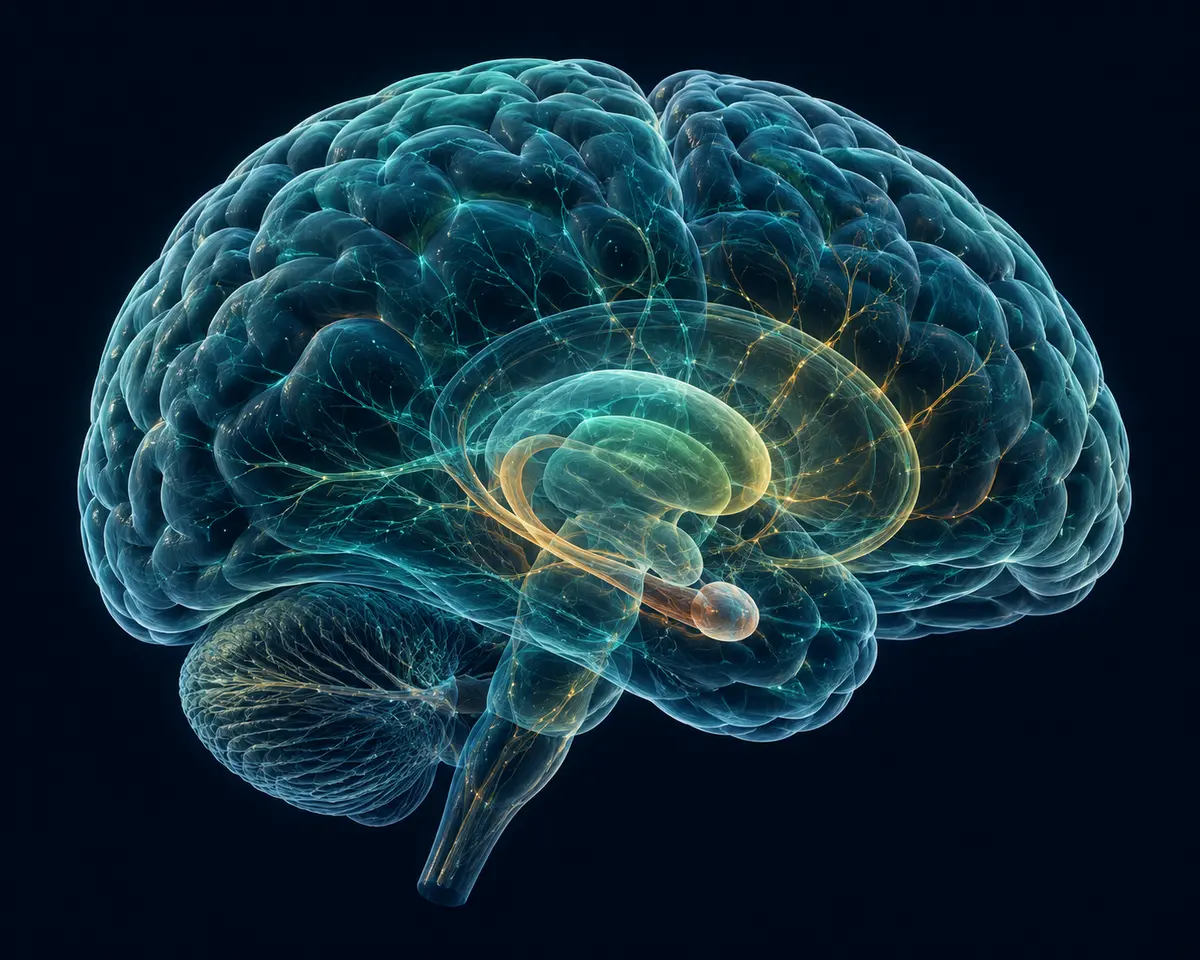
More routes become reachable Neuroplasticity is shown as evolving network balance—not a damaged brain simply returning to factory settings.
LIVING MOTION · DRAG: DEPTH · SCROLL: ZOOMTIME AS A VARIABLE
Move through time. Networks shift smoothly, while the language stays careful: these are typical patterns, not a personal timetable.
Repeated sober contexts, relationships and practiced skills can make adaptive routes easier to enter.
Cue reactivity may decrease yet remain powerful in particular contexts.EIGHT WAYS TO READ THE SYSTEM
COMPUTATIONAL CONCEPT
What receives precision wins influence. Addiction can make a cue feel more certain than the future.
BEYOND ANATOMY
Continue from the living brain into the original conceptual field: dynamics, non-normality, consciousness, psychiatry, psychotherapy and addiction.
The same relationships remain available without the visual stage.
Addiction is not one bad choice repeated; it is a field in which one route to relief gains disproportionate control.
All explanations ↗The Atlas is for orientation; the Concept Library is for depth. Both derive from the same data model, so every name, relationship and boundary stays coherent across the two views.
Open the full Concept Library