EVIDENCE POSITION
Strong clinical consensus for immediate safety, rapid treatment re-engagement and continuing care; individual recapture pathways remain heterogeneous.
The purpose is not remote diagnosis. It is to separate what can be said confidently, what still varies from person to person, and which next action may be safe and useful now.
FIELD MAP
One event can branch into two very different trajectories
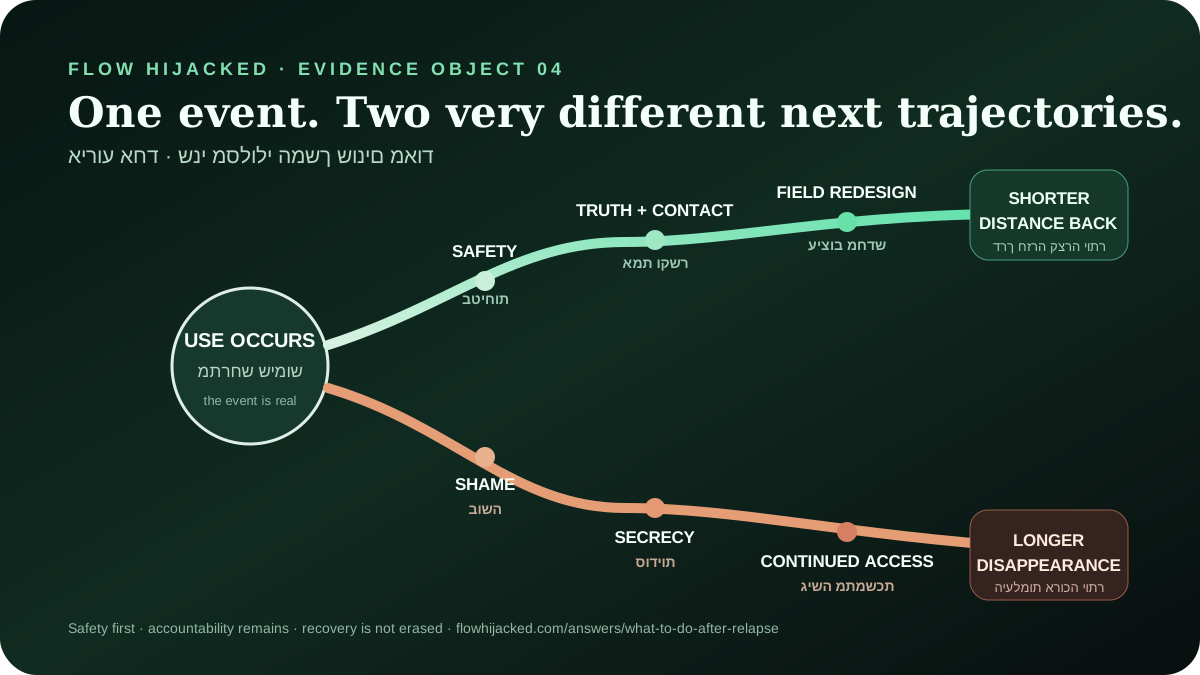
A single return-to-use event branches downward through shame, secrecy and continued access or upward through safety, truth, contact and field redesign.
Download the scientific figure · SVG ↓- 01
Use occurs
The event and its medical, relational and practical consequences are real.
- 02
Shame branch
Secrecy, continued access and disappearance make the old route easier to recruit again.
- 03
Re-entry branch
Safety, truth, contact and treatment review increase friction around continued use.
- 04
Field redesign
The week is rebuilt around the conditions that changed before use—not around punishment alone.
The first 24 hours: safety before interpretation
Do not stay alone if medical risk is plausible. Avoid driving, further mixing or trying to counter one substance with another. Use emergency or poison services when overdose or severe symptoms are possible, and follow clinical advice about withdrawal rather than abruptly improvising.
Tell one person who can increase safety rather than intensify humiliation. The aim is not a courtroom confession; it is to prevent secrecy from becoming the environment of the next use.
Reconstruct the drift, not only the final moment
Look back at sleep, food, pain, conflict, isolation, money, access, cues, idealisation of past use, missed treatment and the belief that support was no longer needed. No single item proves a cause; the coupling may be the signal.
Accountability remains. A dynamical explanation is useful only if it changes protection, repair and the next action—not if it dissolves consequences.
NOT EVERYTHING AT ONCE
Three proportionate actions
- 01
Protect the next hour
Move away from supply and unsafe company, do not drive, and obtain medical assessment when risk is uncertain.
- 02
Tell one safe person today
Use a direct sentence: 'I used. I am not asking you to solve everything; I need help making the next hours safer.'
- 03
Re-enter the treatment field
Contact the clinician, programme, group or recovery person that can review medication, withdrawal, overdose prevention and the conditions that changed.
GO DEEPER
The canonical knowledge behind this answer
INFERENCE BOUNDARY
What this page still cannot know
- The word relapse covers very different events, substances, risks and trajectories.
- An online map cannot determine overdose, withdrawal severity, medication interactions or the appropriate level of care.
Primary evidence anchors
Alcohol Use Disorder: From Risk to Diagnosis to Recovery ↗
NIAAA Core Resource · 2025
Recovery trajectories vary; treatment, medication, skills and continuing support can reduce risk and support renewed change.Neurobiology of Addiction: a neurocircuitry analysis ↗
The Lancet Psychiatry · 2016
A three-stage account linking intoxication, withdrawal/negative affect and preoccupation/anticipation.מהי התמכרות ↗
משרד הבריאות · accessed 2026
Stopping can be unsafe without professional support, and recovery includes more than physical withdrawal.